As readers of this blog know, our elementary school uses an elaborate behavioral rewards program called PBIS. Under the program, teachers reward “well-behaved” students with little string bracelets. The kids can then exchange the bracelets for entries into a prize drawing that occurs at the end of each week. The more bracelets they earn, the better their chance of winning a prize. The school announces the prize winners over the public address system every Friday afternoon.
Last week, though, when the winners were announced, people noticed something strange. One of the winners was a kindergarten-age girl who had registered for school over the summer, but whose parents then decided to keep her in pre-school for an additional year. She doesn’t attend the school. Another winner was a girl who moved to South Dakota several weeks ago.
One can only imagine how two kids who don’t attend the school, but whose names may appear on an outdated school roster, could have won the weekly prize drawing. It certainly makes you wonder whether the school is being honest with the kids about how the winners are chosen.
..
Sunday, October 30, 2011


Friday, October 28, 2011
Perpetual, unwinnable wars (junior edition)
Defenders of PBIS, the behavioral rewards program that our elementary school uses, emphasize how “positive” it is; after all, it aims to reduce the use of punishment by making the school rules very clear and then repeatedly rewarding students who comply with them. (Not getting rewards, when others are getting them, apparently doesn’t count as punishment.) The tradeoff for this “positivity,” though, is that the school has become obsessed with behavior, behavior, behavior, reminding the kids at every opportunity -- in assemblies, in “guidance” class, in the hallways and lunchroom, on the playground, on posters and signs throughout the building, and every time rewards are given -- of its behavioral “expectations.” The (unintentional?) message to the kids is that school is first and foremost about behavior, compliance with rules, and obedience to authority.
Most of these kids were not getting punished much, if it all, before PBIS came along. Now the school is not only continuously reminding them of school rules, but also continuously obsessing over and passing judgment on their behavior. That this might not feel like a “positive” change does not seem to have occurred to anyone.
Moreover, PBIS seems to have generated new “expectations” that didn’t exist before. Take the lunchroom. Before PBIS, the kids got the same measly fifteen-minute lunch break, but were at least largely left alone while they ate. There was an adult present, but that person pretty much stayed in the background unless there was a problem -- for example, helping the younger kids open containers or milk cartons.
With PBIS, though, came the Perpetual War on Lunchroom Noise. We have a lunchroom, so we must have lunchroom expectations, and we must make them clear and insist that they be followed. Suddenly it became the lunchroom attendants’ mission to reduce the noise level. This entails frequently yelling at the kids to be quiet, and usually turning down the lights to make the point. If some kids don’t comply, their entire table has to be silent. There are days when the entire lunchroom is required to eat lunch in silence, because some of the kids have been too noisy. Tables at which the kids are too noisy may be dismissed last, thus getting less time at recess; sometimes the lunchroom attendants expressly threaten to hold the whole room in from recess until they are quieter. Plastic cups of different colors are placed on each table; a green cup means the kids can talk, but if they’re too loud, they get the yellow cup, and can only whisper -- forget about talking to your friend across the table. And if they are still too loud, they get the red cup, which means they have to be silent for the rest of lunch.
A couple of weeks ago, the lunchroom attendants began threatening that if the kids weren’t quieter at lunch, they would start to have assigned seats. This threat came after more than two years of constant scolding about the lunchroom noise levels. For all the yelling and darkening and threats and plastic cups and missed recess time and enforced silence, there is no indication that this lunchroom full of young children is any quieter than it ever was. If anything, judging from the elevation of the threats, it may even be noisier.
Some questions: How did the school go about deciding what an age-appropriate “lunchroom expectation” was? Will the failure to reduce lunchroom noise, after over two years of trying, lead them to reconsider that decision? Or just to adopt increasingly heavy-handed interventions? What’s been gained? Even if noise had been reduced, would it have been worth the price? What is the school modeling about how public institutions should interact with the people they govern? Is the lunchroom now a more “positive” place?
UPDATE: Today the lunchroom attendant had a new, police-like whistle, which she blew loudly to get the kids’ attention. “I’ll blow it again if you don’t quiet down,” she said, prompting some kids to put their hands over their ears. Then she blew it again. What a positive development.
.
Thursday, October 27, 2011
Occupy Iowa City on education

A reader points out that Occupy Iowa City, our local offshoot of the Occupy Wall Street movement, has posted a statement of principles that includes these paragraphs:
We witness the degradation of public schools which do not provide the skills needed for creative and free thought, or for full participation in economic or political systems.I’m very sympathetic to a lot of the concerns that the Occupiers have raised, if not to all of them in every particular. Those statements about education are, of course, unspecific and designed to appeal to a broad range of people. But I don’t think I’m projecting -- especially given their other principles -- when I conclude that the protesters would probably share my concern about public schools that seem designed to produce compliant subjects of a totalitarian state rather than skeptical, questioning citizens capable of participating in a democracy.
. . .
We affirm the necessity of affordable public education for all people, so that they may be fully informed, creative and curious participants in a just society.
I’m also glad to see any acknowledgment that the disturbing economic and political trends in our country -- the increasingly authoritarian view of government, the decline in civil liberties, the two-tiered system of justice, the disproportionate influence of the wealthy, the militarism, the pitting of people against one another to fight over a smaller pie -- might be related to how schools are treating our kids.
I don’t know where this movement will go, but right now, these people are saying some things that need saying.
Related post here.
.
Monday, October 24, 2011
School district survey due tonight
I just received this message from Julie Van Dyke about our school district’s survey on district operations:
Hi Folks,.
The crucial ICCSD survey will close at midnight tonight, Monday, 10/24. Please fwd this request and info to as many ICCSD stakeholders as possible. We can be candid in our comments, as long was we phrase them without indicating who we are, because the surveys go directly to the audit consulting firm - not to the school district. The consulting firm will combine the multiple choice scoring and comments into a report they provide to the district.
Survey at https://proact.wufoo.com/forms/iowa-city-school-district-operational-survey/
Friday, October 21, 2011
The beginning of the end for No Child Left Behind?
The Times reports that the Senate Education Committee, chaired by Iowa Senator Tom Harkin, has approved a bill that “would greatly reduce Washington’s role in overseeing public schools.”
It was a bad idea to put the federal government in charge of our schools, and it would be an even worse idea to keep it in charge after the disaster that was No Child Left Behind. Best of luck to Harkin and the other Senators who support this bill.
.
[The bill] would continue to require states to test students in grades 3 through 8 annually in reading and math, but would eliminate most provisions in the law that put the federal Department of Education in the position of supervising the performance of the nation’s 100,000 public schools. The department would continue to closely oversee how states manage their worst-performing schools.Apparently the bill would release states from the “mandate that schools be deemed failures if all their students were not proficient in reading and math by 2014.” Further, it “would not require states to set any student achievement targets,” and it drops “the requirement that schools evaluate teachers based on student test scores and other methods.”
Civil rights and business groups, including the U.S. Chamber of Commerce said the legislation would so thoroughly eviscerate the federal role in school accountability that they could not support it. But powerful groups representing superintendents, principals, teachers and school boards said they were delighted.Education Secretary Arne Duncan criticized the bill, which is a point in its favor.
It was a bad idea to put the federal government in charge of our schools, and it would be an even worse idea to keep it in charge after the disaster that was No Child Left Behind. Best of luck to Harkin and the other Senators who support this bill.
.
What is PBIS teaching our kids about moral reasoning? (continued)
Under our district’s behavioral rewards program, PBIS, teachers give out token rewards to kids who they “catch” complying with the school’s “expectations” (that is, obeying school rules). Each time a student gets a reward, he or she is entered into a lottery at the end of the week to win a special prize. At our elementary school, for example, the prize might be toy sunglasses, lip gloss, a notebook, some special pencils, candy, or the like. I have many objections to the program; one is that it teaches that the reason to “be good” is to get a material reward -- the most primitive form of moral reasoning, if you’d call it moral reasoning at all.
Recently, at another elementary school in our district, the weekly prize was a pair of tickets to a University of Iowa football game, a prize that might easily have been worth hundreds of dollars. (The tickets had been donated to the school.) Football is big in Iowa City, to put it mildly -- especially among boys. Some of the kids started competing to get behavior rewards like never before. Then, at the end of the week, one student, a kindergartner, won the football tickets. At least one boy was in tears after learning that his week of good behavior didn’t pay off as he had hoped.
If you see a child as nothing but a collection of behaviors, that story might not bother you at all. The prize had exactly its desired effect, after all, in getting kids to comply with school rules. This is precisely how PBIS is supposed to work. Good behavior is up! Office referrals are down! How could anyone complain?
But if you see kids as having minds, and if you care not only about what they do but about why they do it, and if you think that how they understand their world matters, then you might find that story pretty disturbing. On the one hand, I suppose the kids might have learned a valuable lesson about gambling. What they learned about good behavior and moral reasoning, one can only imagine.
.
Friday, October 14, 2011
Public forum on school district “operations”
Julie Van Dyke asked me to let everyone know about this:
UPDATE: And a reminder from Julie's earlier comment: There will be a "Town Hall" meeting with representatives of the Governor's office this Sunday at 1 p.m. at West High about the proposed Education Blueprint.
.
Iowa City Community School District Seeks Public Input On Operations AuditI’m not sure exactly what types of issues fall under the category of “Operations,” which, on its face, would seem to describe everything the school district does. Is it safe to assume that this event is not directed toward such things as curricular concerns or redistricting issues? If anyone has more information, please chime in in the comments.
The Iowa City Community School District will host a public forum Monday, October 17 at 7:00 p.m. at City High Opstad Auditorium to gather input on what community members see as areas needing improvement in the School District Operations. The District has retained an outside firm to engage in a process audit to help look at how the school district does business. The audit will include interviews of District personnel and community members in individual, small group, and open forum settings. It is vital for community members to provide open and honest feedback in the areas of human resources, technology, business, custodial and food services.
UPDATE: And a reminder from Julie's earlier comment: There will be a "Town Hall" meeting with representatives of the Governor's office this Sunday at 1 p.m. at West High about the proposed Education Blueprint.
.
Monday, October 10, 2011
And it’s only the first day of Testing Week
Today the lunchroom guards attendants at our elementary school told the kids (for about the millionth time) that they were being too noisy at lunch. This time, though, they said that if the kids weren’t quieter at lunch tomorrow, there would be assigned seats at lunch for the rest of the year.
I’m sure this had nothing to do with the fact that while some groups were in the lunchroom, other groups were taking the ITBS, our state’s annual week-long high-stakes standardized test.
Completely unrelated cartoon here.
.
I’m sure this had nothing to do with the fact that while some groups were in the lunchroom, other groups were taking the ITBS, our state’s annual week-long high-stakes standardized test.
Completely unrelated cartoon here.

.
Sunday, October 9, 2011
Quote for the week: Iowa Test of Basic Skills edition
“Getting through another year of AYP successfully is like passing a ridiculously large and hard stool. You do it because you have to, there’s a modicum of relief when it’s done, and you pray you haven’t done too much damage when passing it.”
-- Michael Doyle, on the annual gauntlet of standardized testing to meet No Child Left Behind’s “adequate yearly progress” requirements. This week in Iowa City, students will spend hours every day taking standardized tests.
.
-- Michael Doyle, on the annual gauntlet of standardized testing to meet No Child Left Behind’s “adequate yearly progress” requirements. This week in Iowa City, students will spend hours every day taking standardized tests.
.
Saturday, October 8, 2011
Does the Governor love my child?
“I love my child,” a homeschooling mom once said to me. “Does the teacher love my child?” That’s as good an explanation as I have ever heard for homeschooling. It’s also, I think, a good argument for local control over educational policy. The teachers, in my experience, do at least have relationships with the kids and care about them as individuals. Do the school administrators? The superintendent? The Secretary of Education? The Congressperson?
The best way to put power in the hands of the people most likely to treat kids humanely -- that is, parents and teachers -- is to give local communities real control over their schools.
(I didn’t want to let the blog’s second birthday go by without a post. Looks like I just made it under the wire.)
.
Wednesday, October 5, 2011
Why is school choice so unappealing?
I don’t think all schools should be the same. One of my complaints about No Child Left Behind is that it imposes a single educational philosophy on every public school in America: school is about raising short-term standardized test scores, period. That strikes me as wrong not just because I disagree with that philosophy, but because I value pluralism. Moreover, it seems short-sighted: why put all of our eggs in any one basket? Why turn educational policy into a nationwide winner-take-all battle -- especially if there’s a good chance you might lose that battle?
If it were up to me, I’d allow genuine local control over educational policy. There’s no reason that schools in Iowa City should have to follow the same approach as schools in, say, rural Texas, or even schools in more conservative parts of Iowa. Why not let each community do it in its own way? Wouldn’t more people be satisfied that way?
But this idea raises one of the age-old tensions in law and politics. To get more freedom for myself, I have to grant more freedom to other people. Many people in Iowa City might dislike the choices made by that Texas town, and want to put a stop to them. But you can’t have it both ways. Is it more important to preserve our community’s freedom to run its schools as it chooses, or to stop that Texas town from doing its own thing? Remember, if everything is decided at the federal level, it might end up that the Texans are the ones telling Iowa City what to do, not the other way around. Arguably, that is exactly what has happened, and I’m thinking of one Texan in particular.
So you would think that I’d be drawn to the idea of school choice, and at least in theory, I am. But school choice is complicated by yet another issue: we’re making choices about what to do with a completely disenfranchised set of people -- children -- who have no choice in the matter at all. Suppose our district starts up the Corporal Punishment Magnet School, filled entirely by kids whose parents choose it. No one would be forcing me to choose it, so could I object? I think I could.
So even in theory, it’s hard not to have some ambivalence about school choice. Then you see what passes for school choice in practice, and ambivalence turns to skepticism and suspicion. Though some people are making valiant efforts to create charter schools that follow humane educational principles, they can’t escape the law’s requirement that all schools are ultimately judged solely on their success in raising standardized test scores. The kind of choice I’d like to make is simply not allowed.
Meanwhile, though, consider some of the choices that are allowed. When our current Secretary of Education, Arne Duncan, was the head of the Chicago school system, he “oversaw the controversial move to bring full-fledged military academies to the Windy City.” Andy Kroll reports:
Can a pluralist object?
.
If it were up to me, I’d allow genuine local control over educational policy. There’s no reason that schools in Iowa City should have to follow the same approach as schools in, say, rural Texas, or even schools in more conservative parts of Iowa. Why not let each community do it in its own way? Wouldn’t more people be satisfied that way?
But this idea raises one of the age-old tensions in law and politics. To get more freedom for myself, I have to grant more freedom to other people. Many people in Iowa City might dislike the choices made by that Texas town, and want to put a stop to them. But you can’t have it both ways. Is it more important to preserve our community’s freedom to run its schools as it chooses, or to stop that Texas town from doing its own thing? Remember, if everything is decided at the federal level, it might end up that the Texans are the ones telling Iowa City what to do, not the other way around. Arguably, that is exactly what has happened, and I’m thinking of one Texan in particular.
So you would think that I’d be drawn to the idea of school choice, and at least in theory, I am. But school choice is complicated by yet another issue: we’re making choices about what to do with a completely disenfranchised set of people -- children -- who have no choice in the matter at all. Suppose our district starts up the Corporal Punishment Magnet School, filled entirely by kids whose parents choose it. No one would be forcing me to choose it, so could I object? I think I could.
So even in theory, it’s hard not to have some ambivalence about school choice. Then you see what passes for school choice in practice, and ambivalence turns to skepticism and suspicion. Though some people are making valiant efforts to create charter schools that follow humane educational principles, they can’t escape the law’s requirement that all schools are ultimately judged solely on their success in raising standardized test scores. The kind of choice I’d like to make is simply not allowed.
Meanwhile, though, consider some of the choices that are allowed. When our current Secretary of Education, Arne Duncan, was the head of the Chicago school system, he “oversaw the controversial move to bring full-fledged military academies to the Windy City.” Andy Kroll reports:
Today, Chicago has six military high schools run by a branch of the armed services. Six smaller military academies share buildings with existing high schools. Nearly three dozen JROTC programs exist in regular high schools, where students attend a daily JROTC class and wear uniforms to school one day a week. And at the middle school level, there is a JROTC program for sixth, seventh- and eighth-graders.Meanwhile, former Defense Secretary William Cohen is reported to have called JROTC “one of the best recruiting services that we could have.”
Chicago may have the nation’s biggest JROTC program, but it is no longer an anomaly. Due to increases in federal funding for JROTC programs, the military’s presence in public schools is greater than ever before. More than a dozen academies partly funded by the Department of Defense have sprouted up from Philadelphia to Oakland, and the National Defense Authorization Act of 2009 passed last year will increase the number of JROTC units nationwide from 3,400 to 3,700 by 2020, at a cost of $170 million. (Peacework magazine obtained a list of schools that have requested JROTC programs.) The Marines are in discussions to open new JROTC academies in Atlanta, Las Vegas, and New Orleans, helping to expand a program that critics contend has blurred the line between education and recruitment. . . .
Now that Duncan is the nation’s top education official, anti-recruitment activists worry that he will use his position to promote the expansion of JROTC and military academies as solutions for cash-strapped or underperforming school districts. . . . “These are positive learning environments,” Duncan said in 2007. “I love the sense of leadership. I love the sense of discipline.”
Can a pluralist object?
.
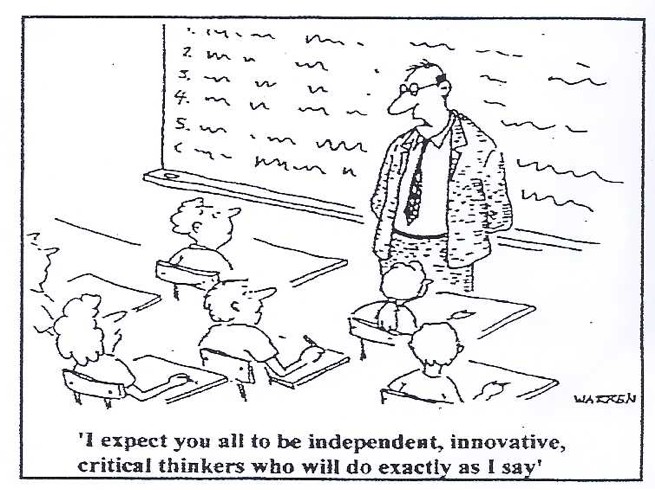
Tuesday, October 4, 2011
Guest post: Authoritarian Education Styles and American Competitiveness
Justin Birch has been reading this blog and asked if he could write the following guest post, which seemed right up this blog’s alley. He tells me that he wanted to be a high school teacher, and then a college professor, before encountering the difficulties of graduate school and professional academia. Now, as a writer and editor, he works to promote the quality and availability of undergraduate education in America.
[UPDATE: In July 2012, onlineschools.org asked me to remove the link to onlineschools.org from this post, on the grounds that “We believe this link may have been compensated by a marketer and no longer want them pointing to the site.” See this post.]
UPDATE 9/26/12: I'm going to go ahead and remove the link to onlineschools.org, even though the site never adequately answered my questions about why the link should be removed. Again, see this post.]
Americans are known for their competitive spirit. Whether the conversation is politics or sports, arguments can quickly grow heated. What happens when we turn that competitive nature to our education system?
It has long been a topic of conversation that changes need to be made in the education system in order for our students to compete on the international stage. Much attention recently has been devoted to the promise of charter schools or online colleges to outperform public institutions. However, it’s helpful to know what’s being compared. The perception reflected by rhetoric about other countries’ education systems is that they churn out perfect little soldiers, able to recite documents and perform complex mathematical functions by rote, but incapable of creativity and free thinking. Although this perception is quite inaccurate, it continues to be propagated by news media and creeps into the consciousness of our educational leaders, influencing their decisions on how best to compete with other countries.
The prime example of the influence of this thinking in action is the No Child Left Behind Act’s requirement that schools must perform according to certain national standards in order to receive funding. Should student scores not reach a minimum acceptable mark, the school is designated “failing” and faces sanction. Progress is only measured in one way, however: standardized testing. The most common criticism of standardized testing is that the only thing it can effectively measure is students’ ability to take standardized tests.
What skills are required to take a standardized test? The ability to follow instructions, memorize isolated facts, and then regurgitate information on demand. By the same token, what does standardized testing fail to measure? Creativity, imagination, emotional intelligence, innovation — all the values that have traditionally been measures of American success.
Professor Yong Zhao of Michigan State University has studied the problem of standardized testing and expressed concern that by forcing our kids to conform to measurable standards through testing of only readily quantifiable subjects (math, science, and reading) Americans are tossing away the very talents that have always given the United States a competitive edge in the world.
The other problem that surfaces when so much emphasis is placed on the results of testing and numbers is that someone will always find a way to game the system. In 2011, a scandal rocked the Atlanta public school system when it was discovered teachers and principals had actually been altering tests taken by students to make it appear test scores were better than they actually were. Who does this benefit?
What kind of future America are we creating with our heavy emphasis on standardized testing? Do we really want a workforce only excellent at obeying instructions and short-term memorization? Do we want cheating and lying to be the only effective way to get ahead? Or do we want creative workers adept and deeper learning who can think around corners and come up with innovative solutions to problems?
To make matters worse, not only are we putting all our eggs in the basket of quantifiable education results, we aren’t even doing it well. The reality is that when it comes to quantifiable test scores we are consistently outperformed by countries like Singapore, Taiwan, and South Korea. However, once again we aren’t truly comparing apples to apples. Students in other countries may begin formal education at different ages, and other factors may lead to the differences in test scores.
In our efforts to create a more authoritarian framework in our schools and thanks to our competitive nature we find ourselves whipping our students to produce better numbers and teaching to the tests, or altering the numbers when they don’t suit us. Students and teachers are sacrificing their innate drive to learning in order to score higher in arbitrary measures of success. If we wish to truly remain competitive in the global market, we must harness the creativity and talents that embody American spirit and teach to those, even if they aren’t so easily quantified.
.
Friday, September 30, 2011
Love it or leave it?
A commenter on this post asked, “Why exactly do you send your children to public schools? It seems as though your tone throughout much of what I have read is that of exteme disbelief in the public school system as a whole. If this is the case, then why not homeschool or send your children to private schools?”
That’s a reasonable question, and I’m afraid the answer isn’t very profound. If I were independently wealthy, and my wife would agree to the idea, and my kids were willing to give it a try, I’d be homeschooling (probably along these lines) in a minute. Unfortunately, I can’t get past even the first item on that list. I’m not willing to give up my career, which is not one that I could just step back into after ten or twelve years away. As for private schools, they are often governed by the same educational philosophies that I’ve objected to on this blog. In any event, there are very few private options here, and none of them excite me enough to justify spending three tuitions times thirteen years (much of which would probably end up coming out of our already inadequate college funds). So here we are.
So I’m certainly not claiming any altruistic “stay and fight” motivation for staying in the public schools. That said, would we really be better off if anyone who was unhappy with the public schools simply took their kids out and paid for private schooling? How would the schools ever change or improve under that approach?
More importantly: taking my kids out of the schools wouldn’t fix what I’m concerned about. Even if I were focused only on my own self-interest, and didn’t care at all about any kids other than my own, I’d still have to worry about what goes in our school system, because I live in a world run by the people who go through it. I worry that authoritarian educational approaches naturally lead, for example, to things like this and then to things like this. I don’t want our schools to model authoritarian values, because I don’t want to live in an authoritarian society. That’s true regardless of whether I happen to have any kids in the system.
When I get asked why I don’t just homeschool, I do wonder about one thing. We’re constantly hearing from school “reformers” who want to make school even more coercive, who want to pile on the schoolwork at younger and younger ages, who want to extend the school day and the school year, and who want ever more intervention into kids’ lives. Do they get asked the same question?
.
Tuesday, September 27, 2011
School board chair: Rewards are unnecessary gimmicks
Our school board tonight elected Marla Swesey, the top vote-getter in the recent school board election, as its new chair. In response to my candidate questionnaire, Swesey, who was a teacher here for twenty-six years, had this to say about using rewards in school:
I won’t get my hopes up that anything will change, but nonetheless it’s nice to hear someone connected with the school system -- the school board chair, no less -- talking sense about the use of rewards in school.
.
I have never been a believer of stickers or prizes used to reward students for good work or behavior. Students should be motivated to feel the intrinsic worth of doing a good job on their schoolwork or doing a good deed. Students are capable of feeling pride in their accomplishments without prizes. Students are naturally curious and should get excited about learning without all the gimmicks. There are times when classes need to celebrate in some way for accomplishments or great deeds that the class achieves. But these celebrations would not be done on a regular basis.Yes, she did go on to say that “this is not a decision for the school board to make but it certainly can be a discussion with the Superintendent so that he can pass on the discussion with the school principals, who in turn can discuss the issue with the teachers.” I think even that approach would be a step in the right direction. Not that long ago, it was probably true that the district itself had no policy about rewards, and the practice probably varied a lot from school to school and teacher to teacher. But I wonder if the new chair realizes that that’s no longer the case, and that the district is now requiring schools to use rewards extensively, and whether that would affect her conclusion about whether the board should have some say in the matter.
I won’t get my hopes up that anything will change, but nonetheless it’s nice to hear someone connected with the school system -- the school board chair, no less -- talking sense about the use of rewards in school.
.
Thursday, September 22, 2011
Data vs. judgment
Gary Gutting has some sanity -- “critical thinking,” even! -- about the limitations of standardized test score data. This passage in particular caught my attention:
But usually what I end up saying is: “Hire good people, give them enough pay and enough autonomy that they’ll stick around and develop wisdom and judgment, and then let them use their wisdom and judgment.” Many people seem to find that unthinkable, and would much prefer the false security of a number, regardless of what that number represents and how that assessment distorts the educational process. Yet my answer is a pretty close description of how our higher education system works. It’s also a pretty good description of Finland’s vaunted educational system. Is it so outlandish to think it might work in our K-12 schools?
I think people distrust that approach because they don’t have faith that our K-12 teachers would have the good judgment necessary to make it work. But isn’t that a self-fulfilling prophecy? We rely more on standardized tests, and teachers are forced to teach to those tests, and their teaching itself becomes standardized, and they have less autonomy in the classroom, and their jobs become less satisfying, and good teachers leave the profession, and fewer qualified people become teachers, and so we trust them even less to have good judgment, and so on. Is that a recipe for good education?
It sometimes seems like people are desperate to find some scientific substitute for individual human judgment. But if we can’t count on our educators to have good judgment, how can we count on them to make good use of standardized test data?
.
There is also the question of whether any standardized test is adequate or needed to evaluate certain sorts of student learning. There was a time when we were happy with Miss Goodteacher’s judgment that her class knew how to read. There are doubtless cases where we can’t trust instructors’ judgments. But is there reason, especially in college-level work, to think that this is generally the case?Sometimes, when I complain about the effect that high-stakes testing is having on K-12 education, I get asked: “But how else can we tell if students are learning, or if teachers and schools are performing well?” I’m never sure what to say first in response to that question. Part of me wants to say, “Yes, it would be great if there were an objective measure of those things, but wishing doesn’t make it so.” Another part wants to say, “But the benefits of using such an imperfect way to assess those things might be far outweighed by the ill effects of using it -- for example, by the increasingly narrow focus of schools on one or two goals -- ‘teaching to the test’ -- at the expense of all others.”
But usually what I end up saying is: “Hire good people, give them enough pay and enough autonomy that they’ll stick around and develop wisdom and judgment, and then let them use their wisdom and judgment.” Many people seem to find that unthinkable, and would much prefer the false security of a number, regardless of what that number represents and how that assessment distorts the educational process. Yet my answer is a pretty close description of how our higher education system works. It’s also a pretty good description of Finland’s vaunted educational system. Is it so outlandish to think it might work in our K-12 schools?
I think people distrust that approach because they don’t have faith that our K-12 teachers would have the good judgment necessary to make it work. But isn’t that a self-fulfilling prophecy? We rely more on standardized tests, and teachers are forced to teach to those tests, and their teaching itself becomes standardized, and they have less autonomy in the classroom, and their jobs become less satisfying, and good teachers leave the profession, and fewer qualified people become teachers, and so we trust them even less to have good judgment, and so on. Is that a recipe for good education?
It sometimes seems like people are desperate to find some scientific substitute for individual human judgment. But if we can’t count on our educators to have good judgment, how can we count on them to make good use of standardized test data?
.
Monday, September 19, 2011
Junk food as a reward, continued
In response to my emails about the use of candy and junk food as a reward in our school, the superintendent forwarded to me an email that went out to all district teachers today (I’ve turned the attachments into links):
Dear Teachers,
This e-mail is to remind you of the district’s Wellness Policy, which states that the district supports and promotes proper dietary habits contributing to students’ health status and academic performance. This includes foods in the classroom. The complete policy is on the district web page, under Health Services and Food Services/ Nutrition. Attached to this e-mail are guidelines for you to follow in implementing the policy, as well as a parent handout.
** Please note the following highlights from the policy as you plan your classroom celebrations, request or bring classroom snacks, plan fundraising with student-sponsored clubs, and consider using foods as rewards for students.
Sunday, September 18, 2011
Buy now, pay later
One thing that drives me crazy is when people use a narrowly-defined short-term “gain” to justify intervening in kids’ lives, without regard to the long-term consequences. Using elaborate reward systems means fewer referrals to the principal’s office! Piling on homework will raise third-grade standardized test scores! Even if there were evidence to support these assertions, who would define success so narrowly? I’d much rather raise a kid who enjoys reading than one whose third-grade test scores are higher but who thinks of reading as a chore.
I’ve been meaning for some time to link to this article by Marcia Angell in the New York Review of Books. It reviews three books that discuss the increasing diagnosis of mental illness and the corresponding increase in the use of psychiatric drugs. If what the authors say is true, the story is basically one long parade of short-term thinking at the expense of long-term well-being, with a big dose of corporate avarice and bad government policy driving it all:
.
I’ve been meaning for some time to link to this article by Marcia Angell in the New York Review of Books. It reviews three books that discuss the increasing diagnosis of mental illness and the corresponding increase in the use of psychiatric drugs. If what the authors say is true, the story is basically one long parade of short-term thinking at the expense of long-term well-being, with a big dose of corporate avarice and bad government policy driving it all:
For obvious reasons, drug companies make very sure that their positive studies are published in medical journals and doctors know about them, while the negative ones often languish unseen within the FDA, which regards them as proprietary and therefore confidential. This practice greatly biases the medical literature, medical education, and treatment decisions.The review then specifically focuses on the increasing use of psychiatric drugs on children:
. . .
Whereas [Irving] Kirsch concludes that antidepressants are probably no more effective than placebos, [Robert] Whitaker concludes that they and most of the other psychoactive drugs are not only ineffective but harmful.
. . .
Moreover, Whitaker contends, the natural history of mental illness has changed. Whereas conditions such as schizophrenia and depression were once mainly self-limited or episodic, with each episode usually lasting no more than six months and interspersed with long periods of normalcy, the conditions are now chronic and lifelong. Whitaker believes that this might be because drugs, even those that relieve symptoms in the short term, cause long-term mental harms that continue after the underlying illness would have naturally resolved.
What should be of greatest concern for Americans is the astonishing rise in the diagnosis and treatment of mental illness in children, sometimes as young as two years old.The whole thing is really a must-read. Part 1 is here; part 2 is here.
. . .
The apparent prevalence of “juvenile bipolar disorder” jumped forty-fold between 1993 and 2004, and that of “autism” increased from one in five hundred children to one in ninety over the same decade. Ten percent of ten-year-old boys now take daily stimulants for ADHD—“attention deficit/hyperactivity disorder”—and 500,000 children take antipsychotic drugs.
. . .
One would be hard pressed to find a two-year-old who is not sometimes irritable, a boy in fifth grade who is not sometimes inattentive, or a girl in middle school who is not anxious. (Imagine what taking a drug that causes obesity would do to such a girl.) Whether such children are labeled as having a mental disorder and treated with prescription drugs depends a lot on who they are and the pressures their parents face. As low-income families experience growing economic hardship, many are finding that applying for Supplemental Security Income (SSI) payments on the basis of mental disability is the only way to survive.
. . .
In December 2006 a four-year-old child named Rebecca Riley died in a small town near Boston from a combination of Clonidine and Depakote, which she had been prescribed, along with Seroquel, to treat “ADHD” and “bipolar disorder”—diagnoses she received when she was two years old.
. . .
Rebecca’s two older siblings had been given the same diagnoses and were each taking three psychoactive drugs. The parents had obtained SSI benefits for the siblings and for themselves, and were applying for benefits for Rebecca when she died. The family’s total income from SSI was about $30,000 per year.
.
Saturday, September 17, 2011
Mandatory patriotism
I’ve posted before (here, here, and here) about the irony of trying to teach democratic values using authoritarian methods, so this Op-Ed in today’s Times, on “Constitution Day,” caught my eye. It focuses on the federal law requiring schools that receive federal funds to provide educational programming to observe Constitution Day. (As I went to link to it, I realized it was written by an old friend with whom I’ve fallen out of touch.) An excerpt:
.
Since Constitution Day is not a particularly well-known holiday, its mandatory patriotism may not seem like a big deal. But mandatory patriotism is corrosive even if accomplished bit by bit.Read the whole piece. As I noted here, our school’s new principal has decided to personally lead the kids in saying the Pledge every day. Why?
Consider the Pledge of Allegiance, recited by tens of millions of students every school day. Most schools are obligated by state or local laws to start the day with the pledge, but the real target of the pledge laws are the kids. Children have a constitutional right to opt out, but a refusal is so fraught with social risk that it is not a real alternative for most. The reaction to the rare child who refuses proves the point: last year, for instance, a Maryland teacher yelled at a 13-year-old girl who refused to recite the pledge and called a school security officer to escort her from the classroom. . . .
We should recall Justice Robert H. Jackson’s words from almost 70 years ago, in his opinion protecting the right of students to refuse to recite the pledge: “To believe that patriotism will not flourish if patriotic ceremonies are voluntary and spontaneous, instead of a compulsory routine, is to make an unflattering estimate of the appeal of our institutions to free minds.”
.
Wednesday, September 14, 2011
What is PBIS teaching our kids about moral reasoning?
From Engaging Troubling Students: A Constructivist Approach, by Scot Danforth and Terry Jo Smith (emphasis mine):
.
An important question for educators to ask involves the distinction between “shaping” students’ behaviors and promoting their moral development. Lawrence Kohlberg (1967, 1984), a developmental psychologist, developed a hierarchical schema of moral development through which he believes children evolve. . . .I don’t know if I buy completely into Kohlberg’s theory. But “premoral” sounds like just the right word for PBIS. Why are our schools modeling and encouraging this “morally bankrupt” way of thinking?
Thomas (1992) explains that in the first stage of the Preconventional [or Premoral] Level, referred to as the Obedience and Punishment Orientation, a child judges whether an action is good or bad based on whether it results in a punishment. Doing the “right thing” is equated with avoiding punishment. This judgment does not involve the human meaning of the act, just its consequences. The second stage of the Preconventional Level is referred to as the naive instrumental level. This stage involves actions based on what “pays off” for the child, not on a sense of justice or loyalty. . . .
The second level of moral development in Kohlberg’s schema is the Conventional Level and involves conformity to the expectations of the family, group, or nation. The third level is the Postconventional Level, in which moral behavior is first defined in terms of individual rights but advances toward universal principles of justice.
Behavior modification is the systematic enactment of the Premoral Level of development. This is particularly problematic in light of Kohlberg’s beliefs about how moral development is fostered. . . . Kohlberg theorized that the environmental aspects affecting children’s moral development are “(1) the child’s opportunities to learn social roles and (2) the form of justice in the social institutions with which the child is familiar” (Thomas, 1992, p. 503).
The behavior modification systems commonly used in schools, according to Kohlberg’s schemas, do not involve moral reasoning at all. Drummed into students’ heads all day is the morally bankrupt message of “behave and you’ll be rewarded.” If the form of justice in social institutions affects moral development, as Kohlberg has suggested, then classrooms provide promising opportunities to promote moral development. In particular, a classroom culture that is based on the concept of a community has the potential to promote moral development that involves rights and responsibilities, as well as relationships between the individual and the group. We are deeply concerned by the long-term impact of classrooms that operate on premoral principles.
.
Tuesday, September 13, 2011
Live-blogging the school board election results
Consider this your source for nerdy commentary on the school board election returns as they come in tonight. For precinct-by-precinct results, read the updates that appear below the tables. For information on the candidates, click here.
Monday, September 12, 2011
Misguidance
During the first week of school, as part of our district’s “guidance curriculum,” the fifth- and sixth-grade classes started a unit on study skills. To introduce the unit, the teacher put a page up on the overhead projector with the heading, in large letters:

The page then contained a list of statements, including:
Where to begin? How about with the outright falsity of what they’re teaching these kids? Your performance in school -- in fifth grade, no less! -- determines the quality of your future life? The person you marry? The satisfaction you get from spare time activities? These are the kind of pseudo-scientific factoids that our kids should learn to be skeptical of. Instead, they’re encouraged to swallow them whole: YES, IT’S A FACT! Please, show me the empirical research supporting these assertions.
I’m sure one could find studies showing correlations between, say, high school or college grades and income. Correlation, of course, doesn’t prove causation, because another cause -- socioeconomic status? -- might be driving both variables. But even if you could prove that getting good grades in college has, for many people, some independent effect on income, it would still be false to say that your performance in fifth grade, or any grade, “determines” the quality of your future life.
As one girl said to her friend, “You should have brought up Einstein.” Or, I thought, George W. Bush.
Second, “station in life”?! Does the district really mean to teach that everyone has a “station in life” that is fixed by the time they finish school? And to pass that “fact” along without any reflection on whether it is just or unjust?
Third, what a vision of school! Did anyone stop to consider that portraying school as a thirteen-year sentence in a labor camp, preceded by a stern lecture, might not be the best motivational strategy? (The word “job” appears six times.) What does it say about the district’s faith in the quality of its classroom experiences that it chooses to use fear as the main motivator for going to school? What does it say about the district’s understanding of motivation? What does it say about the district’s own attitude toward the learning process?
As another parent said after reading the list, “It’s as if they’ve never been intellectually interested in anything in their lives.”
Finally, what about the kids who are struggling? What will this do to their motivation? If they’re trying hard and still not “performing well,” what message -- other than frustration and despair -- will they take away from this presentation, as they anticipate their lowly, inevitable, and apparently deserved “station in life”?
Click the image to see the whole sheet.
 .

The page then contained a list of statements, including:
Your performance in school determines the quality of your future life: size of income -- person you marry -- station in life -- satisfaction from spare time activities -- etc.
Up to one third of your life is spent in school.
Your main job at this time is studying, being a student.
You are “paid” with knowledge and grades for going to school.
Getting high grades is only one of many rewards of a good student. Even more important is the satisfaction that comes from a job well done -- the best job you are capable of doing! PRIDE!
Studying will be a burden unless YOU do something to make it enjoyable.
The skills you learn and the habits you adopt will remain with you throughout your life.
You become an expert only after continual practice.
Unless you work with each skill repeatedly, the skill will be lost!
Reward yourself if you do a good job.
Where to begin? How about with the outright falsity of what they’re teaching these kids? Your performance in school -- in fifth grade, no less! -- determines the quality of your future life? The person you marry? The satisfaction you get from spare time activities? These are the kind of pseudo-scientific factoids that our kids should learn to be skeptical of. Instead, they’re encouraged to swallow them whole: YES, IT’S A FACT! Please, show me the empirical research supporting these assertions.
I’m sure one could find studies showing correlations between, say, high school or college grades and income. Correlation, of course, doesn’t prove causation, because another cause -- socioeconomic status? -- might be driving both variables. But even if you could prove that getting good grades in college has, for many people, some independent effect on income, it would still be false to say that your performance in fifth grade, or any grade, “determines” the quality of your future life.
As one girl said to her friend, “You should have brought up Einstein.” Or, I thought, George W. Bush.
Second, “station in life”?! Does the district really mean to teach that everyone has a “station in life” that is fixed by the time they finish school? And to pass that “fact” along without any reflection on whether it is just or unjust?
Third, what a vision of school! Did anyone stop to consider that portraying school as a thirteen-year sentence in a labor camp, preceded by a stern lecture, might not be the best motivational strategy? (The word “job” appears six times.) What does it say about the district’s faith in the quality of its classroom experiences that it chooses to use fear as the main motivator for going to school? What does it say about the district’s understanding of motivation? What does it say about the district’s own attitude toward the learning process?
As another parent said after reading the list, “It’s as if they’ve never been intellectually interested in anything in their lives.”
Finally, what about the kids who are struggling? What will this do to their motivation? If they’re trying hard and still not “performing well,” what message -- other than frustration and despair -- will they take away from this presentation, as they anticipate their lowly, inevitable, and apparently deserved “station in life”?
Click the image to see the whole sheet.

Candidates’ responses: Patti Fields
Patti Fields, who had contacted me a week or two ago to say that she was working on my candidate questionnaire and hoped to finish her answers in time to reply before the election, just sent me a response to most of them:
1. Should the school board ensure that elementary school students get more than fifteen minutes for lunch? If so, what should the minimum lunch period be? (See the petition about this issue here.)
1. Should the school board ensure that elementary school students get more than fifteen minutes for lunch? If so, what should the minimum lunch period be? (See the petition about this issue here.)
I am going to answer this question in two different roles.2. On balance, has the No Child Left Behind Act been good for Iowa City’s public school children?
As a board member, this is not an appropriate issue for the board to review. It is a programming, staffing and building-level decision. There is an appropriate process for this issue to come the board through the Board Complaint process. This process is available to anyone with a concern that they do not feel has been handled appropriately in the district.
As a parent, of course I want my child to have enough time to eat lunch for healthy eating habits and choices. The difference is between respecting the appropriate roles of a board member and a parent.
Why I’m voting for Julie VanDyke
The geeky political junkie in me has enjoyed covering the school board election on this blog. But to the parent and voter in me, it’s felt more like a duty than a pleasure. I think what our schools need more than anything is an infusion of local democracy. School board elections are our best shot at translating our community values into educational policy, so I wanted to make as much of that opportunity as I could. Yet as I attended the forums and read the candidates’ statements and profiles in the paper, it was hard for my eyes not to glaze over. There was some good discussion of budget and oversight issues, and some real disagreement there. But on most everything else, there were platitudes and bland agreement. (The most common answer, by far, at the candidates’ forums was “I agree with the other candidates.”) And there was the usual conspicuous absence of any discussion about how our kids are actually being educated: about the choices a district faces in how to help kids learn and grow.
It would go too far to compare the candidate forums to Nero fiddling while Rome burned. But to me, the biggest issue in education, by far, is the way that No Child Left Behind is dumbing down and impoverishing our kids’ education -- not just by putting negative labels on schools and teachers, but by changing the content of what goes on in the classroom, and the way kids experience and think about learning. That issue strikes me as far more important than, say, where to put the boundary between City and West. Yet most of the candidates made little or no mention of NCLB in their personal statements or at the candidate forums.
Yes, I know -- school board members don’t have the power to repeal NCLB. But I think that’s a lame rejoinder. They can minimize the harm only if they’re conscious of how bad it is. Moreover, precisely because they don’t have the power to change NCLB, and precisely because they’re tasked with carrying out its damaging mandates, they should be raising hell about it at every opportunity. Where is the outrage?
At one of the forums, the candidates were asked about the use of standardized test scores by our schools. Incredibly, only one candidate mentioned NCLB in her answer: Julie VanDyke. Until she did, I had begun to feel like the candidates and I were looking at two different school systems on two different planets.
I had that same response to VanDyke’s responses to my candidate questionnaire. I don’t mean to disparage the other candidate’s responses; I admire the other four candidates who responded, especially given how unresponsive some of our current board members have been to people’s questions. And several other candidates did recognize that NCLB has had harmful effects. But only when I read VanDyke’s response did I feel that I was in the presence of a person who is seeing the same world I’m seeing:
In general, I thought VanDyke’s other answers also exhibited a humane and thoughtful understanding of education. I also remain struck by the fact that in Iowa City, home of one of America’s great research universities, the candidates for school board are unwilling to say (in response to my question 6) that indoctrination has no place in education, period. VanDyke’s answer came closest to my feelings on that issue as well.
Yes, as many people have pointed out, VanDyke is not Ms. Diplomacy. She can be combative and “uncivil.” I don’t deny that, and I hope that she can find a way to focus her strong feelings clearly on issues and not on people. But I hope she never becomes so civil that she’s unwilling to denounce in the strongest terms possible the things that need denouncing, like No Child Left Behind. I’d rather have a board member who errs on the side of strong feeling than one who is so polite and civil that you’d barely know anything is wrong. This is especially true given the temptation that board members face to be hands-off and let the district run itself. VanDyke certainly sounds like someone who can resist that temptation.
I plan on casting four votes in the election for the four-year seats, too -- probably for Hoelscher, McGinness, Swesey, and either Hemingway, Porter, or Tate. (Although I wasn’t crazy about Hoelscher’s responses to my questions, she grew on me at the candidate forums. And she did answer the questions, after all, which counts for something.) I’m sure that if any of my candidates are elected, I’ll probably be giving them a hard time in this space before long. So let me give them all their due right now: being a board member, or even running for the board, is a huge and largely thankless sacrifice. As someone who can barely find time to write a blog post every week or two, I don’t know how they do it. We should all be grateful that anyone would take it on.
.
It would go too far to compare the candidate forums to Nero fiddling while Rome burned. But to me, the biggest issue in education, by far, is the way that No Child Left Behind is dumbing down and impoverishing our kids’ education -- not just by putting negative labels on schools and teachers, but by changing the content of what goes on in the classroom, and the way kids experience and think about learning. That issue strikes me as far more important than, say, where to put the boundary between City and West. Yet most of the candidates made little or no mention of NCLB in their personal statements or at the candidate forums.
Yes, I know -- school board members don’t have the power to repeal NCLB. But I think that’s a lame rejoinder. They can minimize the harm only if they’re conscious of how bad it is. Moreover, precisely because they don’t have the power to change NCLB, and precisely because they’re tasked with carrying out its damaging mandates, they should be raising hell about it at every opportunity. Where is the outrage?
At one of the forums, the candidates were asked about the use of standardized test scores by our schools. Incredibly, only one candidate mentioned NCLB in her answer: Julie VanDyke. Until she did, I had begun to feel like the candidates and I were looking at two different school systems on two different planets.
I had that same response to VanDyke’s responses to my candidate questionnaire. I don’t mean to disparage the other candidate’s responses; I admire the other four candidates who responded, especially given how unresponsive some of our current board members have been to people’s questions. And several other candidates did recognize that NCLB has had harmful effects. But only when I read VanDyke’s response did I feel that I was in the presence of a person who is seeing the same world I’m seeing:
NCLB has lead to a nationwide culture of shame, blame, negativity, hopelessness, and punishment in K-12 education. . . .It’s about time! This was the only statement I heard from any candidate that came close to recognizing the full disaster that is No Child Left Behind.
Teaching to the test, almost a requirement at this point, has further decimated time and funding spent on all areas with the exception of reading and math. Art, physical education, science, history and the humanities in general have been reduced or cut entirely. The most gifted students have lost access to resources and teaching staff they need to excel, while the below average children have the life and joy stripped out of their school day replaced by preparation for standardized tests. . . .
The culture of failure labeling and impossible goals that has grown out of NCLB has negatively impacted the morale of the entire public education system: from administrators-to teachers-to students-to parents-to communities.
In general, I thought VanDyke’s other answers also exhibited a humane and thoughtful understanding of education. I also remain struck by the fact that in Iowa City, home of one of America’s great research universities, the candidates for school board are unwilling to say (in response to my question 6) that indoctrination has no place in education, period. VanDyke’s answer came closest to my feelings on that issue as well.
Yes, as many people have pointed out, VanDyke is not Ms. Diplomacy. She can be combative and “uncivil.” I don’t deny that, and I hope that she can find a way to focus her strong feelings clearly on issues and not on people. But I hope she never becomes so civil that she’s unwilling to denounce in the strongest terms possible the things that need denouncing, like No Child Left Behind. I’d rather have a board member who errs on the side of strong feeling than one who is so polite and civil that you’d barely know anything is wrong. This is especially true given the temptation that board members face to be hands-off and let the district run itself. VanDyke certainly sounds like someone who can resist that temptation.
I plan on casting four votes in the election for the four-year seats, too -- probably for Hoelscher, McGinness, Swesey, and either Hemingway, Porter, or Tate. (Although I wasn’t crazy about Hoelscher’s responses to my questions, she grew on me at the candidate forums. And she did answer the questions, after all, which counts for something.) I’m sure that if any of my candidates are elected, I’ll probably be giving them a hard time in this space before long. So let me give them all their due right now: being a board member, or even running for the board, is a huge and largely thankless sacrifice. As someone who can barely find time to write a blog post every week or two, I don’t know how they do it. We should all be grateful that anyone would take it on.
.
Sunday, September 11, 2011
Candidates’ responses: Julie VanDyke
1. Should the school board ensure that elementary school students get more than fifteen minutes for lunch? If so, what should the minimum lunch period be? (See the petition about this issue here.)
Given the attention span of most small children I know, 15 minutes for lunch is unacceptably short. Given the attention span of ADD/ADHD, 15 minutes for lunch is inhumane and counterproductive. The ICCSD’s Wellness policy includes the following:2. On balance, has the No Child Left Behind Act been good for Iowa City’s public school children?
“The school district provides a comprehensive and integral learning environment for developing and practicing lifelong wellness behaviors. The entire school environment, not just the classroom, shall be aligned with healthy school district goals to influence a student’s understanding, beliefs and habits as they relate to healthy nutrition and regular physical activity.”
“The school district supports and promotes proper dietary habits contributing to students’ health status and academic performance.”
Neither of these assertions is evidenced in by the district’s 15 minute lunch. Everything I read on healthy eating indicates that food should be eaten slowly and chewed one bite at a time, not inhaled and rushed down with milk. I assume that the shorter lunch periods are a direct result of NCLB’s pressure to spend every possible moment in class towards more progress on standardized testing. I don’t think the board can mandate a longer lunch but I think elementary students need a minimum of 20 minutes to be able to eat enough food in the healthiest manner. I would do everything I could to help the Superintendent and district administration re-evaluate the lunch period towards extending it to 20-25 minutes. I would have gladly signed the petition to do so. This isn’t going to make me popular but then, honesty is more important to me than popularity…I would like to see High Fructose Corn Syrup (HFCS) containing foods and condiments removed from the breakfasts and lunches provided by the school district. Frequently eating foods containing transfats, lots of added sugar, high saturated fat, HFCS, pesticide residue, MSG and artificial dyes is not healthy. I believe they are at the root of the obesity crisis and the skyrocketing number of ADD/ADHD cases (maybe even the increase in autism spectrum incidence) in this country. One of the main problems with HCFS is that it interferes with leptin and insulin which subsequently impairs the body’s ability to properly regulate and store energy. Please see this link for the most recent research from Princeton http://www.princeton.edu/main/news/archive/S26/91/22K07/. These studies are also helpful: http://www.jci.org/articles/view/37385 and http://jcem.endojournals.org/content/94/5/1562.full.pdf . I hope to see more research published on HFCS’s affect on behavior in the future. Since fructose and HFCS have not been integrated into food processing/manufacture in the European Union, as opposed to the United States, it would be interesting to compare the two in regards to increases in prevalence of obesity, ADD/ADHD, and Autism Spectrum Disorders.
Friday, September 9, 2011
Junk food as a reward
I just sent this email to our school superintendent:
UPDATE 1: Here is the superintendent's reply:
UPDATE 2: My reply:
.
Hi -- I’ve noticed with increasing frequency that our elementary school is using junk food -- candy, bubble gum, licorice, etc. -- as a reward for “good behavior.” I dislike the district’s pervasive use of rewards to get kids to obey school rules, but using junk food for that purpose is particularly objectionable, especially in a society where childhood obesity is becoming an epidemic. It also seems to violate the district’s wellness policy. Would you be willing to make it clear that ICCSD schools should not use junk food as a reward?I'll post any reply that I receive.
Thank you for your consideration.
UPDATE 1: Here is the superintendent's reply:
Thank you for bringing this to my attention. While in my previous district I worked to end the sale of all pop during the school day and eliminate the use of candy and other related food as rewards in classrooms. We develop a very comprehensive Food and Beverage Guideline. I cannot locate a copy of that this morning, however, I will do so and bring that to Susie Poulton, Director of Health and Student Services.Readers, is that a “No”?
I know that you have been very active in working to improve the nutrition focus in our District. I recently worked with Assistant Superintendent Becky Furlong to review with our principals the current lunch practices. Some of the changes made last year seem to be working at some schools. Others are not working as well. Becky is working with the Elementary Principals to gather a comprehensive records of the current lunch room practices so that the schools can learn from each other and work to provide the best environment for the children. One promising practice that has been reported is the movement of recess prior to lunch. I know from the reports at my house that at both the elementary and junior high school levels that students still have concerns about the length of the lunch period. While we have not identified a solution that meets all expectations, we are working to that end.
If you have further input on either of these issues, I would welcome additional correspondence or a call.
UPDATE 2: My reply:
Thanks for the quick reply. What I'm after is an authoritative statement from the district prohibiting the use of junk food as a reward in school. I don't think that would require the passage of a new policy; just an application of the existing wellness policy. I can certainly understand wanting to hear from Susie Poulton on the issue first, but am I right to assume that you make the ultimate call on how to interpret that policy? If so, how long do you anticipate it will take to make that decision? The practice of using junk food as a reward seems so plainly indefensible that it would surprise me if there had to be a lengthy consideration of the issue. Would we be talking about a few days?His very quick reply:
Good Afternoon Chris,My reply:
The short answer is yes, I make that decision and yes, that should not require a lengthy re-write of policy.
I want to make sure that appropriate members of the administrative are part of the decision and on board with enforcement to insure that it is not a proclamation in name only.
Sounds reasonable. Any time frame?His reply:
I have to meet with Susie on another issue on Monday morning. If we have enough time we will add this to the agenda. If not, I am sure we can make some determination before the end of the week.To which I responded, "Terrific -- thank you." Stay tuned . . .
.
Wednesday, September 7, 2011
The incredible shrinking lunch period
I currently have a guest post over at The Lunch Tray on the so-far discouraging story of our local effort to get the schools to allow more than a measly fifteen minutes for lunch.
The Lunch Tray, by the way, is a great source of information on the topic of improving school lunches, both system-wide and one family at a time. It’s written by a concerned parent, Bettina Elias Siegel, and features an occasional terrific rant of the type that is right up this blog’s alley (for example, here, here, and here). It’s worth checking out.
.
Thursday, September 1, 2011
Scenes from the first week of school
I’ve written many posts here complaining about our district’s extensive use of rewards to manipulate the kids’ behavior, and about its overemphasis on obedience at the expense of critical thinking. I’m afraid, though, that those posts sometimes get a little too abstract; it’s hard to fully convey my objections without providing a more concrete sense of what is happening in our elementary school. So here is a description of a few of the things that happened during the first week of school.
On the first day at our elementary school, all the kids had to attend a school-wide assembly, at which the new principal made several announcements.
First, she said that every morning on the public address system, she would be leading the Pledge of Allegiance and the Hoover School Pledge, after which there would be a “patriotic song.”
Second, she told the kids that there would be changes in the behavioral rewards program (PBIS) that the school has been using for two years. Instead of receiving red tickets for good behavior, the kids would now receive colorful rope bracelets that they could wear on their arms. The red tickets used to end up in people’s pockets or desks, she explained; now people will be able to see just by looking at a child that he or she has been congratulated. She explained that the kids could choose whether to keep the bracelets or turn them in for entries into the weekly prize lottery. Unlike in previous years, when the prize was usually a special lunch with the principal, the prizes would now be material goods -- little toys, for example.
Third, she explained that there would be a new system for addressing behavior in the lunchroom. Each sixteen-person lunch table would have a plastic cup placed on it. If the kids at that table were well-behaved, the cup would be green, and the kids could talk in normal conversational voices (“voice level 2”) for the duration of the fifteen-minute lunch period. If the kids were too noisy, though, they would get a yellow cup, and would be allowed only to whisper. If they continued to be too noisy, they would get a red cup, and all the kids at the table would have to eat their lunches in silence.
The next day, each classroom of kids was taken on a lengthy tour of the “Expectation Stations,” to be told the “expectations” (translation: rules) for each area of the building. In the hallways, for example, they were to be completely silent, and to walk only on the right side, and only in single file -- no stepping out of line. Even when they’re outside the building on their way to the temporary building, they should be totally quiet and follow the hallway rules. The teacher told them that in the junior high, the students walk chaotically and noisily through the halls, and that they wouldn’t like that at all.
The groups of kids -- even the sixth graders, who are eleven years old and in their seventh year of elementary school -- were then taken into the girls’ bathroom, where the guidance teacher told them not to hang on the stall doors, not to write on the walls, to use no more than two pushes on the towel dispenser, and only one or two squirts of soap (unless it’s really low; then you can use a third). “If you sprinkle when you tinkle,” the teacher told them, “be neat and wipe the seat.” “If it doesn’t look nice, flush twice.” The kids were taken on similar tours of the lunchroom expectations (those cups again), and the playground expectations.
“They treat us like babies,” one child said afterward.
____________
On the first day at our elementary school, all the kids had to attend a school-wide assembly, at which the new principal made several announcements.
First, she said that every morning on the public address system, she would be leading the Pledge of Allegiance and the Hoover School Pledge, after which there would be a “patriotic song.”
Second, she told the kids that there would be changes in the behavioral rewards program (PBIS) that the school has been using for two years. Instead of receiving red tickets for good behavior, the kids would now receive colorful rope bracelets that they could wear on their arms. The red tickets used to end up in people’s pockets or desks, she explained; now people will be able to see just by looking at a child that he or she has been congratulated. She explained that the kids could choose whether to keep the bracelets or turn them in for entries into the weekly prize lottery. Unlike in previous years, when the prize was usually a special lunch with the principal, the prizes would now be material goods -- little toys, for example.
Third, she explained that there would be a new system for addressing behavior in the lunchroom. Each sixteen-person lunch table would have a plastic cup placed on it. If the kids at that table were well-behaved, the cup would be green, and the kids could talk in normal conversational voices (“voice level 2”) for the duration of the fifteen-minute lunch period. If the kids were too noisy, though, they would get a yellow cup, and would be allowed only to whisper. If they continued to be too noisy, they would get a red cup, and all the kids at the table would have to eat their lunches in silence.
____________
The next day, each classroom of kids was taken on a lengthy tour of the “Expectation Stations,” to be told the “expectations” (translation: rules) for each area of the building. In the hallways, for example, they were to be completely silent, and to walk only on the right side, and only in single file -- no stepping out of line. Even when they’re outside the building on their way to the temporary building, they should be totally quiet and follow the hallway rules. The teacher told them that in the junior high, the students walk chaotically and noisily through the halls, and that they wouldn’t like that at all.
The groups of kids -- even the sixth graders, who are eleven years old and in their seventh year of elementary school -- were then taken into the girls’ bathroom, where the guidance teacher told them not to hang on the stall doors, not to write on the walls, to use no more than two pushes on the towel dispenser, and only one or two squirts of soap (unless it’s really low; then you can use a third). “If you sprinkle when you tinkle,” the teacher told them, “be neat and wipe the seat.” “If it doesn’t look nice, flush twice.” The kids were taken on similar tours of the lunchroom expectations (those cups again), and the playground expectations.
“They treat us like babies,” one child said afterward.
Candidates’ responses: Marla Swesey
1. Should the school board ensure that elementary school students get more than fifteen minutes for lunch? If so, what should the minimum lunch period be? (See the petition about this issue here.)
School lunch time has been an issue for a long time in the ICCSD and I suspect other districts, too. Although, it isn’t a school board decision to be made- it still deserves discussion as it is something that can be approached by the Superintendent when he talks to the principals about scheduling. At the beginning of the school year, the principals have to decide on the scheduling for all the specials, including the lunch/recess times for all classes. It is a tough job. Most schools have 15 min. for eating and then 15 min. for noon recess. The rationale behind the recess after the lunch time is to provide whatever extra time is necessary for kids to finish their lunches before they go out for recess. If a slow eater takes longer to eat, the extra eating time is taken off of their recess time. In all the years that I taught, I didn’t see too many students giving up their recess time to finish eating. Many times, I saw students rushing to eat so they would get more recess time. Some schools or classes in schools, have recess before lunch so that there is no extra time for the students to eat if they are only given 15 minutes. It would be nice to have 20 minutes of eating time and 15 minutes of recess but principals would have to do some creative scheduling to make that happen. Is it possible? Perhaps one of the meetings scheduled for the Superintendent and the principals could be used to talk about some of the creative ways that more time for school lunch could be accomplished.2. On balance, has the No Child Left Behind Act been good for Iowa City’s public school children?
Sunday, August 28, 2011
One-stop shopping for the school board election
I want this post to serve as a collecting spot for information about the candidates in our local September 13 school board election. I will keep adding to it as more information becomes available. I’m sure I’m missing things; please feel free to suggest additional links in the comments or via email. (I hope you’ll also feel free to check out some of the site’s other posts while you’re here.)
ELECTION RESULTS
For live-blogging of the election results as they come (as well as early reports on turnout), click here.
THE BASICS
Eight candidates are competing for four at-large seats on the board. In addition, voters will choose between two candidates, Julie Van Dyke and Karla Cook, to fill the unexpired term of Mike Cooper. As a result, five members of the seven-member board will be chosen in this election. Here's what the ballot will look like. Find your polling place here. (Go to your “school precinct,” not your “regular precinct.”)
The polls will be open from 7 am to 8 pm on Tuesday, September 13. Same-day voter registration is permitted. Absentee ballots must be requested by Friday, September 9, and postmarked by Monday, September 12.
Voters will also decide whether to approve a new bond for Kirkwood Community College.
QUESTIONNAIRES
This blog’s questionnaire to the candidates, with links to their responses
The teachers’ union’s questionnaire and responses
Press-Citizen’s “Questions to Ask School Board Candidates”
DEBATES
I know of four scheduled debates:
The September 6 debate will be replayed on local cable channel 21 on:
COMMENTARY
This blog’s posts on the election
Commentary by John Deeth here and here
The teachers’ union summary of the candidates’ pros and cons
Press-Citizen: Reasons to learn more about the school board election
Iowa City Patch: Live-blog commentary on September 1 forum
Another local blogger's take on the September 1 forum
Press-Citizen: Vote yes on the bond issue
Press-Citizen endorses Cook, Swesey, McGinness, Hoelscher, and Porter
More commentary by Mariaconz
The Gazette: Why to vote
Mariaconz's election eve thoughts
Iowa City Patch: Live-blog commentary on the September 8 debate
Press-Citizen: Daunting tasks face everyone who wins today
This blog's choice: Why I'm voting for Julie VanDyke
NEWS COVERAGE
Press-Citizen: Ten candidates seek school board seats
Gazette: Plenty of candidates for school board
Coverage of August 29 debate here
Press-Citizen: Hoelscher to hold forum
Press-Citizen: School board hopefuls sound off at forum
Hoelscher to host listening posts
Federation of Labor endorses Tate, Fields, McGinness, and Porter
Coverage of the September 6 debate is here
Press-Citizen: Teachers' union endorses Cook, Swesey, Fields, Porter, and Hemingway
Coverage of the September 8 debate is here
McGinness to attend coffee event Sunday
John Deeth: McGinness Top School Spender
Daily Iowan: School Board candidates discuss transparency, enrollment
CANDIDATE STATEMENTS AND PROFILES
Jeff Alden: Statement, statement, profile
Karla Cook: Statement, statement, profile
Patti Fields: Statement, statement, profile
Phil Hemingway: Statement, statement, profile, profile
Sally Hoelscher: Statement, statement, profile
Jeff McGinness: Statement, statement, profile, profile, interview
Bob Porter: Statement, statement, profile
Marla Swesey: Statement, statement, profile
James Tate: Statement, statement, profile
Julie VanDyke: Statement, statement, profile
CANDIDATES’ CONTACT INFO
Available here.
CAMPAIGN WEBSITES
Patti Fields
Sally Hoelscher website, Facebook page
Jeff McGinness
Marla Swesey
Julie VanDyke
.
ELECTION RESULTS
For live-blogging of the election results as they come (as well as early reports on turnout), click here.
THE BASICS
Eight candidates are competing for four at-large seats on the board. In addition, voters will choose between two candidates, Julie Van Dyke and Karla Cook, to fill the unexpired term of Mike Cooper. As a result, five members of the seven-member board will be chosen in this election. Here's what the ballot will look like. Find your polling place here. (Go to your “school precinct,” not your “regular precinct.”)
The polls will be open from 7 am to 8 pm on Tuesday, September 13. Same-day voter registration is permitted. Absentee ballots must be requested by Friday, September 9, and postmarked by Monday, September 12.
Voters will also decide whether to approve a new bond for Kirkwood Community College.
QUESTIONNAIRES
This blog’s questionnaire to the candidates, with links to their responses
The teachers’ union’s questionnaire and responses
Press-Citizen’s “Questions to Ask School Board Candidates”
DEBATES
I know of four scheduled debates:
Monday, August 29 at 7 pm, Hills Community Center, 100 E. Main Street, Hills;The September 1 debate is available here as a podcast.
Thursday, September 1 at 6:30 pm, Iowa City Public Library;
Tuesday, September 6 at 7 pm., City High (focused on curriculum and funding); and
Thursday, September 8 at 7 pm, West High (focused on redistricting).
The September 6 debate will be replayed on local cable channel 21 on:
September 7 at noon, 2 pm, 4 pm, and 9 pm;The September 8 debate will be replayed on local cable channel 21 on:
September 8 at 10 am, noon, 2 pm, 4 pm, and 9 pm;
September 9 at 2 pm;
September 10 at 8 am, 5 pm, and 9 pm; and
September 11 at 8 am, 5 pm, and 9 pm.
September 9 at 10 am, noon, 4 pm, and 9 pm;The September 6 and 8 debates are organized by the District Parent Organization; historically, those debates have had a pretty tightly constrained format. The September 1 debate is sponsored by the Press-Citizen and the Iowa City Education Association; historically, their format has been more of a free-for-all.
September 10 at 10 am, 3 pm, and 7 pm;
September 11 at 10 am, 3 pm, and 7 pm; and
September 12 at 10 pm, 2 pm, and 9 pm.
COMMENTARY
This blog’s posts on the election
Commentary by John Deeth here and here
The teachers’ union summary of the candidates’ pros and cons
Press-Citizen: Reasons to learn more about the school board election
Iowa City Patch: Live-blog commentary on September 1 forum
Another local blogger's take on the September 1 forum
Press-Citizen: Vote yes on the bond issue
Press-Citizen endorses Cook, Swesey, McGinness, Hoelscher, and Porter
More commentary by Mariaconz
The Gazette: Why to vote
Mariaconz's election eve thoughts
Iowa City Patch: Live-blog commentary on the September 8 debate
Press-Citizen: Daunting tasks face everyone who wins today
This blog's choice: Why I'm voting for Julie VanDyke
NEWS COVERAGE
Press-Citizen: Ten candidates seek school board seats
Gazette: Plenty of candidates for school board
Coverage of August 29 debate here
Press-Citizen: Hoelscher to hold forum
Press-Citizen: School board hopefuls sound off at forum
Hoelscher to host listening posts
Federation of Labor endorses Tate, Fields, McGinness, and Porter
Coverage of the September 6 debate is here
Press-Citizen: Teachers' union endorses Cook, Swesey, Fields, Porter, and Hemingway
Coverage of the September 8 debate is here
McGinness to attend coffee event Sunday
John Deeth: McGinness Top School Spender
Daily Iowan: School Board candidates discuss transparency, enrollment
CANDIDATE STATEMENTS AND PROFILES
Jeff Alden: Statement, statement, profile
Karla Cook: Statement, statement, profile
Patti Fields: Statement, statement, profile
Phil Hemingway: Statement, statement, profile, profile
Sally Hoelscher: Statement, statement, profile
Jeff McGinness: Statement, statement, profile, profile, interview
Bob Porter: Statement, statement, profile
Marla Swesey: Statement, statement, profile
James Tate: Statement, statement, profile
Julie VanDyke: Statement, statement, profile
CANDIDATES’ CONTACT INFO
Available here.
CAMPAIGN WEBSITES
Patti Fields
Sally Hoelscher website, Facebook page
Jeff McGinness
Marla Swesey
Julie VanDyke
.
Saturday, August 27, 2011
The teachers’ union on the school board election
When I sent out my questions for school board candidates, I mentioned how most such questionnaires tend to focus on “budgets, buildings, and boundaries,” with little, if any, attention to the district’s educational philosophies, approaches, and goals. The Iowa City Education Association (i.e., the local teachers’ union) has its own questionnaire -- the responses to it are here, and their summary of the candidates’ pros and cons is here -- which I think demonstrates my point. Eleven questions, and not one that invites any discussion of what the district’s educational mission should be, or even acknowledges that there might be more than one way to think about educating people. (Number 7 arguably qualifies, but is pretty narrowly focused on accommodating socioeconomic diversity.)
Don’t get me wrong: I think the ICEA is asking about important issues, and I’m happy to link to them here. But as a parent, what I most want to know is: Why is the district treating my children this way? Why does it seem to be striving so hard to teach my kids that learning is an unpleasant chore? Why is it so bent on turning my kids into quiet, obedient little worker bees who will score high on standardized tests and fear authority, instead of skeptical, questioning citizens who will speak up and think for themselves? Why does the district have such a blinkered idea of how people learn, and such an impoverished conception of what it means to be well-educated?
As I’ve made clear before, I don’t mean this as a criticism of the teachers. This approach to education is being imposed on the teachers partly by the district and partly by individual principals. We have no way of knowing how the teachers really feel about it, and I think many of them strive to keep as much joy in the learning process as they can, under the circumstances.
Deborah Meier frequently talks about how schools should be striving to create a “feisty, democratically savvy citizenry.” Our district, though, seems to want to stamp out all traces of anything resembling feistiness from the kids. For the kids who are deemed “disruptive,” we’ve adopted million-dollar programs and entire curricula to train them -- and all the kids -- not just to obey the rules, but to internalize and agree with them. For the kids who are too people-pleasing, too quiet and docile, too unquestioningly obedient, too happy to be told what to think, too fearful of authority -- nothing. The district doesn’t see those kids as a problem. In fact, they appear to represent the district’s ideal student.
Why?
.
Friday, August 26, 2011
Candidates’ responses: Karla Cook [Updated 8/29]
Karla Cook just sent me a partial response to my candidate questionnaire, and said that she “will continue to work on your concerns and questions,” which I hope means that more responses will be coming. In the meantime, here are her thoughts on two of the questions:
1. Should the school board ensure that elementary school students get more than fifteen minutes for lunch? If so, what should the minimum lunch period be? (See the petition about this issue here.)
.
1. Should the school board ensure that elementary school students get more than fifteen minutes for lunch? If so, what should the minimum lunch period be? (See the petition about this issue here.)
As to the lunch time issue, I talked with a parent at Hoover and 2 grandmothers in the district. The parent thought the time was appropriate. However, the grandmothers indicated that they thought the children appeared to be rushed. I would be in favor of allowing the children to finish their lunches whether that was 15-25 minutes. It would be taken out of the lunch recess or whatever activity that was planned for that extra time. I would hope that no school personnel would encourage students to eat too fast or throw away needed food.3. Do you think that standardized testing plays too large a role in our school system? If so, what should the school board do about it?
When I taught at City High, we were concerned with "teaching to the test" in order to make our schools look good. We determined that it would not encourage students to become life-long learners - just momentary-learners, enough to do O.K. on the test. I know that happens in other states and districts. From the number of schools on the SINA list in Iowa City, I think that is not happening here. I am not in favor of "high stakes" testing in any part. Standardized testing is supposed to be a measure of how much progress a student is making. It is not always a good measure as some students do not test well for what ever reason.5. Do you support the current pervasive use of token rewards to get students to comply with school rules? If not, what role should the school board take in reining that practice in?
I read some of the blogs and while I agree that students should not be rewarded for what should be normal good behavior, I know that some students have not received the appropriate parenting before attending school. This is still obvious in some students at the high school level. That leaves the schools to deal with teaching the behaviors that are needed in school. It is hard to have a group of students treated differently than the rest. I would imagine that the teachers have decided that all students will be rewarded so that the ones who are in need of the instruction will not stand out.Links to other candidates’ responses are here.
I would hope that the reinforcement of the behaviors by giving token rewards would taper off as the student population becomes accoustomed to the rules.
.
Candidates’ responses: Sally Hoelscher
1. Should the school board ensure that elementary school students get more than fifteen minutes for lunch? If so, what should the minimum lunch period be? (See the petition about this issue here.)
It is the responsibility of the School Board to make policy decisions, not operational decisions. Therefore, the amount of time designated for lunch is not under the purview of the Board, but rather a decision of the administration of each school. As a parent, you are entitled to (and I believe, correct to) be an advocate for your children on this issue. Building principals and the superintendent are the officials to address these concerns to, as you have done. When my children were in elementary school, I also acted as an advocate for them on lunch issues. I do know that some elementary schools have made some in their lunch procedure for this school year.2. On balance, has the No Child Left Behind Act been good for Iowa City’s public school children?
Monday, August 22, 2011
Candidates’ responses: Jeff McGinness
Jeff McGinness, one of our school board candidates, is the first to reply to my list of questions. Here are his responses (I’ve added a link to the article he mentions):
1. Should the school board ensure that elementary school students get more than fifteen minutes for lunch? If so, what should the minimum lunch period be? (See the petition about this issue here.)
1. Should the school board ensure that elementary school students get more than fifteen minutes for lunch? If so, what should the minimum lunch period be? (See the petition about this issue here.)
Unquestionably, yes. My oldest Gavin, now in second grade at Weber, requests home lunch everyday because he knows his time is limited if he has to stand in line for school lunch. If an 8 year old recognizes the problem such that he changes his own habits I question how the district cannot similarly recognize the issue. I know the administration is finally starting to look at the issue because I had a conversation with Steve Murley in which he mentioned his own kids doing the same thing.2. On balance, has the No Child Left Behind Act been good for Iowa City’s public school children?
One option being talked about is placing the scheduled recess following lunch, instead of before or at some other time. It has had some success at a few of our schools and gives kids more time. The obvious concern is that kids may then voluntarily shorten their own lunch to go play. Thus, they should look at extending the time by 5 minutes in addition to moving around recess times.
Subscribe to:
Posts (Atom)