Showing posts with label Corporate education. Show all posts

Saturday, December 13, 2014

Local control, we hardly knew ye

At last we have a simple test for whether a legislator or state official has even a shred of belief (beyond empty lip service) in the idea of local control in education:
Do you believe that the state, rather than local school districts, should decide what day the school year must begin?
If there are any arguments for why that should be a state decision, rather than a local one, I have yet to see them anywhere.

Nearly every school district in Iowa has requested an exemption from the state-mandated start date, but the state knows better. After all, there are tourism and State Fair profits at stake. (There’s a petition here, if you’re interested.)

At the local level, of course, people can reasonably disagree about when the school year should start. Personally, I like the current calendar for our district. School starts awfully early, but so does the university calendar, which affects many parents in the district. Many university workers are nine-month employees, whose on-campus duties wrap up in May. Extending school until late June will simply shorten the summer for those families, since the parents have to be back on campus in mid-August regardless. Either that or the parents will pull their kids out of school in early June because the family’s summer plans take them elsewhere.

But surely there are people in the district who would prefer the later start (and even some who would prefer—ugh—year-round school). Fine, hash it out democratically and let the school board, not the state, decide.
.

Saturday, March 29, 2014

“He will be a good employee for the job”

Iowa City parent Scott Samuelson has a great opinion piece in today’s Wall Street Journal on the real value of teaching the humanities. He cites research showing that undergraduate humanities majors earn more than those who major in professional or pre-professional fields, but argues:
Thinking of the value of the humanities predominately in terms of earnings and employment is to miss the point. America should strive to be a society of free people deeply engaged in “the pursuit of happiness,” not simply one of decently compensated and well-behaved employees.
Scott’s book, “The Deepest Human Life: An Introduction to Philosophy for Everyone,” comes out next week.

Meanwhile, our school district’s “Guidance” program had fourth- and sixth-graders learning job interview skills this week. In some classes, the kids played the parts of employer and job applicant and then evaluated the applicant’s interview skills. Was the applicant “clean, neat and well-groomed”? Did he have “Hands relaxed (not clenched)”? Did he “honor the end of the interview”? The interviewers then wrote overall comments, such as “He seems like a good employee.” Here’s an example:

(Click to enlarge.)

The Iowa Core, after all, has twenty-five pages of mandatory standards devoted to “employability skills.” See if you can find the Iowa Core sections devoted to philosophy or the arts.
.

Monday, June 17, 2013

Wishful building


In the course of our district’s facilities planning process, we’re hearing dazzling visions of what the Classroom of the Future will look like. In the future, the district’s consultants tell us, education will be “student-centered,” so:
Buildings and grounds should provide a variety of spaces for hands-on activities, project-based learning, student collaboration, research and study space, and presentations.
The consultants showed us pictures of spacious classrooms where students work together at communal tables, while teachers work with one or two students at a time. None of the pictures showed a classroom with more than sixteen students in it.

The process has succeeded in getting at least some in the community talking about what kind of education we should be designing our schools for. I’ve recently heard parents, for example, envisioning classrooms in which the teacher is the “guide on the side” rather than the “sage on the stage,” and where students spend more time working collaboratively on solving problems, and where there is more “critical thinking” and less rote memorization.

That conversation is great to hear, even if it is just in its early stages. But I have to wonder whether we’re deceiving ourselves that “student-centered” education is the wave of the future. Everything indicates the opposite. State and federal laws have increasingly imposed a standardized vision of education on all kids. The newly imposed Iowa Core standards require teachers to cover a very particular—and extensive—body of content in each grade. They are accompanied by lengthy standardized tests to make sure that everything on the list gets covered. And “accountability,” many argue, requires us to make teachers’ jobs and raises depend on how well their students do on those standardized tests. Meanwhile, our state’s education department has taken the position that “improving educator effectiveness” is a better use of money than reducing, or even maintaining, current class sizes.

If your job depends on making sure a big group of kids knows an extensive, predetermined body of knowledge well enough to score high on a standardized test, how much project-based learning will you allow? How much will you be a “guide on the side”? How much time will you have to “foster creativity”? Anyone want to guess how the desks are arranged in a Kaplan SAT prep class, or how much independent inquiry goes on there? I’m afraid that’s what our standardized-test-driven future looks like.

Our district decides what the buildings look like, but the state and federal governments decide what goes on inside them. During the facilities planning process, we’re being encouraged to picture our dream schools. Once the money is spent and the buildings are built, what type of education will we actually get?
.

Saturday, April 27, 2013

We need stimulus, not STEM

In my last two posts, I argued that the national push for STEM—that is, using education policy to push students toward careers in science, technology, engineering, and math—is a form of corporate welfare. But isn’t it possible that pushing STEM might reduce unemployment and help us get out of this recession?

Don’t bet on it. The argument for pushing STEM is not only dubious, it’s part of a larger dubious argument about what’s wrong with our economy and how we should fix it. Here’s Paul Krugman discussing research by economist Edward Lazear:
Lazear’s question is whether a large part of the rise in unemployment is “structural”, that is, reflecting supply factors, or whether it’s mainly simple lack of demand. The Keynesian view is, of course, that it’s demand, and that fiscal and monetary policy should be acting to provide the missing demand. On the other side you have either supply-side views a la Mulligan claiming that taxes and benefits are discouraging people from working, or more or less Austrianish views that it’s about maladaption of the structure of production that left too many workers and too much capital stuck in the wrong industries.

Lazear goes through the data, and finds overwhelming evidence of inadequate demand, little if any evidence of structural problems.
In other words, the argument for pushing STEM is brought to you by the same people who brought you fiscal austerity, and who—as Krugman never tires of reminding us—have been wrong about everything.

If the problem is inadequate demand, the fix is fiscal stimulus, not education policy. Funny how often education proposals function as substitutes for addressing real economic ills.

More from Freddie deBoer here.
.

Friday, April 26, 2013

The myth of “unfilled STEM jobs”

Yesterday I posted about a study arguing that the shortage of qualified job applicants in science, technology, engineering, and math (STEM) is a myth. I can’t vouch for that study’s analysis, but isn’t the whole concept of “unfilled positions” inherently suspect?

Just as every house sells if you price it low enough, every job opening gets filled if the salary is high enough. To say that there are “unfilled openings” is to say that employers would happily hire more people if only the prevailing market wage were lower. But that is not peculiar to STEM; it is generally true in any industry.

To say that there are “not enough qualified applicants” is no different. I promise: if you offer enough money, you’ll find a qualified applicant. Yes, the total number of qualified applicants is limited by how attractive a given career path is relative to others. If the salaries are only so attractive, only so many people will go into that field. To complain about it is to complain that market forces are limiting your profits. Poor you!

If accountants were willing to work for minimum wage, it’s a safe bet that accounting firms would increase their hiring. Think of all those “unfilled positions”! That is not an argument for government intervention to increase the supply of accountants.

I’m counting on someone with a more sophisticated understanding of economics than mine to let me know where I’m going wrong here—though at least this guy seems to agree with me.
.

Thursday, April 25, 2013

Is the push for STEM just corporate welfare?

The Washington Post reports on a study arguing that the STEM worker shortage is a myth—that in fact there are lots of STEM grads and not enough STEM jobs for them to fill.

I remain puzzled by the national push for STEM (that is, increased emphasis on education in science, technology, engineering, and math). Regardless of that study’s accuracy, won’t government intervention to increase the supply of labor in a particular industry inevitably lead to lower wages in that industry? Who benefits?

If you’re a liberal, shouldn’t you be bothered by government interventions that seem designed to lower wages in a particular industry?

If you’re a conservative, shouldn’t you oppose government interventions like these, and put your faith in the invisible hand of the market?

If you like big-government corporate welfare, though, this sounds like the program for you.
.

Tuesday, February 5, 2013

Bumper sticker for a new century: “Well-behaved girls please their teachers”

This study has been getting a lot of attention this week. Here’s Christina Hoff Sommers in the Times:
Boys score as well as or better than girls on most standardized tests, yet they are far less likely to get good grades, take advanced classes or attend college. Why? A study coming out this week in The Journal of Human Resources gives an important answer. Teachers of classes as early as kindergarten factor good behavior into grades — and girls, as a rule, comport themselves far better than boys.

The study’s authors analyzed data from more than 5,800 students from kindergarten through fifth grade and found that boys across all racial groups and in all major subject areas received lower grades than their test scores would have predicted.

The scholars attributed this “misalignment” to differences in “noncognitive skills”: attentiveness, persistence, eagerness to learn, the ability to sit still and work independently. As most parents know, girls tend to develop these skills earlier and more naturally than boys.

No previous study, to my knowledge, has demonstrated that the well-known gender gap in school grades begins so early and is almost entirely attributable to differences in behavior. The researchers found that teachers rated boys as less proficient even when the boys did just as well as the girls on tests of reading, math and science. (The teachers did not know the test scores in advance.) If the teachers had not accounted for classroom behavior, the boys’ grades, like the girls’, would have matched their test scores.
The commentary that I’ve read has focused entirely on how this means that boys are now academically disadvantaged compared to girls. I don’t doubt that the phenomenon the study describes is bad for boys, but I think it’s every bit as bad for girls, and maybe worse. The “classroom behavior” “skills” that the study identifies—“attentiveness, task persistence, eagerness to learn, learning independence, flexibility and organization,” all based on teacher reports—sound a lot like how a school would describe kids who do as they’re told, always pay attention, are never difficult, comply with all “expectations,” and don’t draw attention to themselves in way that makes trouble. (Call me a cynic, but I can’t help but think that “learning independence” means something closer to “don’t bother the teacher” than to “think independently.”)

If school rewards girls because they are more docile and compliant with the expectations of authority figures, that’s hardly good news for girls. For one thing, those are exactly the traits we shouldn’t want to develop in the people who will one day be deciding our elections. And even if we just look narrowly at the kids’ future employment: are those really the traits that will enable those girls to someday succeed on an equal basis with those “poorly behaved” boys? Or would being assertive and strong-willed potentially come in handy? (What happened to that old bumper sticker, “Well-behaved women never make history”?)

That this study is somehow good news for girls is a conclusion you could reach only if you think of education entirely in terms of maximizing grades, or entirely in terms of producing the ideal Walmart cashier.

Sommers concludes that “fairness today requires us to address the serious educational deficits of boys and young men.” Ugh, I can’t help but fear where that’s going: the solution is to make sure that schools train boys to be much more docile and compliant. Instead, how about we re-examine our “expectations” and our educational goals, and start encouraging traits that will enable all kids to become assertive and independent-minded members of a democratic society?

Related post here.
.

Friday, January 25, 2013

Cracks in the wall?

From Gov. Jerry Brown’s State of the State speech yesterday in California:
The laws that are in fashion demand tightly constrained curricula and reams of accountability data. All the better if it requires quiz-bits of information, regurgitated at regular intervals and stored in vast computers. Performance metrics, of course, are invoked like talismans. Distant authorities crack the whip, demanding quantitative measures and a stark, single number to encapsulate the precise achievement level of every child.

We seem to think that education is a thing—like a vaccine—that can be designed from afar and simply injected into our children. But as the Irish poet, William Butler Yeats said, “Education is not the filling of a pail but the lighting of a fire.”

This year, as you consider new education laws, I ask you to consider the principle of Subsidiarity. Subsidiarity is the idea that a central authority should only perform those tasks which cannot be performed at a more immediate or local level. In other words, higher or more remote levels of government, like the state, should render assistance to local school districts, but always respect their primary jurisdiction and the dignity and freedom of teachers and students.

Subsidiarity is offended when distant authorities prescribe in minute detail what is taught, how it is taught and how it is to be measured. I would prefer to trust our teachers who are in the classroom each day, doing the real work – lighting fires in young minds.

My 2013 Budget Summary lays out the case for cutting categorical programs and putting maximum authority and discretion back at the local level—with school boards.
I don’t know how much Brown can back those words up; there’s a limit to how much local control you can allow if you don’t opt out of No Child Left Behind. But it will be interesting to see how it plays out.

I think the bipartisan consensus favoring centrally-driven school “reform” is finally starting to break down. It is increasingly associated with polarizing right-wing governors like Scott Walker and Rick Snyder. Reformer-in-chief Michelle Rhee is increasingly identified as a “right-wing” figure. (Charles Pierce, a blogger revered on the left, takes on Rhee here.) The Democratic Party activists who populate DailyKos see school reform (accurately) as an attack on unionism. I’d love to see the approval ratings of the standardized testing industry. And now the governor of the largest state in the union is declining to follow the crowd.

It’s got a ways to go. (Blogger Atrios recently tweeted “a liberal member of congress spoke to me about michelle rhee as if she was jesus.”) But if large parts of one party’s base start turning against the top-down “reform” project, how long before “local control” becomes the safest, most people-pleasing position?

Previous post on Jerry Brown here.
.

Tuesday, January 8, 2013

The cogs seem less engaged lately

Gallup reports that kids grow less engaged in school as the years go on:
Nearly eight in 10 elementary students who participated are engaged with school. By middle school that falls to about six in 10 students.

And by high school, only four in 10 students qualify as engaged.
The executive director of Gallup Education, Brandon Busteed, who is scheduled to be the keynote speaker at the Business Summit on Education Reform in Des Moines today, had this reaction:
Imagine what our economy would look like today if nearly eight in 10 of our high school graduates were engaged — just as they were in elementary school.
Could it be that looking at kids primarily in terms of economic stimulus is part of the problem?
.

Thursday, September 20, 2012

McMarketing

Yesterday, the kids at our elementary school attended an assembly at which Ronald McDonald told them about the importance of giving back to one’s community. Yeah, I know, McDonald’s does a lot of fine charity work. That doesn’t change the fact that Ronald McDonald is a walking advertisement for a fast-food restaurant. (“Ronald McDonald appears as a community service,” the website says, “courtesy of your nearby McDonald’s Restaurant.”) Is the school unable to talk to kids about community service without the aid of a corporate marketing ploy?

For what it’s worth, I know at least one child who described Ronald as “creepy.” I agree.
.

Sunday, July 22, 2012

Are for-profit online schools gaming Google (and me)?

This is something of a long story, and a pretty trivial one, but it gets curiouser and curiouser, so I think it’s worth telling.

Last year, I got an email from a Justin Birch, asking if he could write a guest post for this blog. He identified himself as a writer for onlineschools.org, and proposed to write on a topic that seemed to fit the blog. I had never had anyone ask to write a guest post before, and I told him I was open to the idea, but that I would have to see the post before I decided whether to accept it.

I should have paid more attention to his connection to onlineschools.org. That site prominently advertises for-profit online schools such as the University of Phoenix and Kaplan University. In 2010, federal investigators revealed that for-profit schools, including Phoenix and Kaplan, had engaged in “deceptive or questionable” practices to recruit students. As the Times reported, “recruiters would lure students — often members of minorities, veterans, the homeless and low-income people — with promises of quick degrees and post-graduation jobs but often leave them poorly prepared and burdened with staggering federal loans.” Some of the schools were accused of misleading applicants, or of encouraging applicants to commit fraud on their federal loan applications. (Video here.) The picture that emerged, in the words of InsideHigherEd, was of “an industry aggressively and universally going after ‘leads’ and ‘starts’ with the institutional objective of securing federal financial aid dollars.” Picture a school run by the characters of Glengarry Glen Ross.

I briefly wondered about Birch’s connection to online schools, but I didn’t discern any ulterior motive in his guest post. I figured he was just wanted to be able to say he had some online publications. His proposed post didn’t promote online schools, though it did mention them in passing, with a link to onlineschools.org. I wasn’t surprised that he threw in a link to his employer, and didn’t give it a second thought. I agreed with the thrust of the post, which is what I most cared about. So I went ahead and posted it.

Weeks went by and the post eventually slipped down off the front page. Meanwhile, though, I began to get emails from other people – “freelance writers” – wanting to write guest posts. Some of them mentioned that all they wanted in exchange was a link to their website. Some of the writers cited websites such as onlineuniversities.com, bestonlinedegree.org, and, again, onlineschools.org. One person wrote, “I am a freelancer and so for your posting of this original article I would be able to pay you.” There was obviously something fishy going on, so I declined these offers, when I responded at all.

Monday, July 16, 2012

Preparing our kids for the workplace

We’ve reached the point at which ad campaigns can depict workers courageously demanding not better health care benefits or decent wages or collective bargaining rights but . . . to be given a few minutes for lunch.

Is this what Iowa City schools are teaching our kids to expect?

C/o digby. Related Times article here.
.

Saturday, June 9, 2012

Mad scientists, cont’d

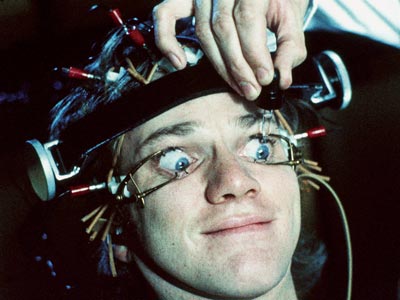
I may have to start a new post label for Clockwork Orange analogies. Here’s the description of a $498,055 grant funded by the Bill & Melinda Gates Foundation through Clemson University:
Purpose: to work with members of the Measuring Effective Teachers (MET) team to measure engagement physiologically with Galvanic Skin Response (GSR) bracelets which will determine the feasibility and utility of using such devices regularly in schools with students and teachers
Forget about reducing class size. This is where our Corporate Reforming Overlords think the future lies.

(C/o Diane Ravitch’s Blog. Earlier Clockwork Orange references here and here.)
.

Wednesday, April 11, 2012

R.I.P., local control

The Iowa State House of Representatives has just passed this bill – because our state overseers cannot rest if even one school district is operating on a different calendar!

I have often thought it’s crazy that our district starts school so early in the year – this year on August 16. At the same time, though, I know that Iowa City is a university town, and I’m usually grateful that my kids are in school during that week, since I start teaching my own classes the following week.

Reasonable people could certainly disagree about the best time to start school. But what possible reason is there for the state to intervene?

Oh, I mean, other than boosting attendance at the state fair and making money for the tourism industry.
.

Sunday, February 26, 2012

Teacher: “It is as bad as you think and probably worse”

Commenter “Another Chris” posted a comment on the previous post (“Are liberal homeschoolers hypocrites?”) that deserves a post of its own, so I’m reprinting it here in full:
Chris, I have to side with you on this one and I am a public school teacher. From an insiders perspective it is as bad as you think and probably worse in many respects. Teachers have lost all control over what happens in the classroom.

In many places we now have “walkthroughs” which is the latest fad quick-fix and principals and boards love them because they are all about keeping teachers “accountable” and under control.

Administrators and district employees do frequent, short drive-bys in classrooms with checklists of what they “should” be seeing in “effective” classrooms. There is no discussion before or after in most places but rather a notice in your mailbox of how badly you were out of compliance and how short a time you have to remedy this error.

The very idea that a 3 - 5 minute inspection provides even a tiny snapshot of the dynamics of teaching and learning with a group of diverse children is offensive yet this is a major tool in evaluating teachers now in most of the country. Horror stories from teachers abound, from kids hiding under the desks when the “scary people” come through to kids challenging the visitors on their rudeness in interrupting their learning.

Curriculum is carefully controlled from on high and one of the checklists’ major foci is to make sure each teacher is doing the prescribed lesson in the prescribed way at the prescribed time. You will be penalized if off track no matter how well-reasoned your explanation, such as individualizing instruction.

Our president, whom I campaigned and voted for, stated in his big education speech last month that teachers need to “stop teaching to the test!” which was very cognitively dissonant since his own education department’s Race to the Top program has required all participating states to make test scores anywhere from 40 - 60% of a teacher’s evaluation, which elevates a single test score to prime importance. So we’re supposed to ignore the biggest part of the decision on whether we get to remain employed or not and/or even retain our teaching license and risk losing years and years of college education, continuing education, and thousands of dollars invested in both?

Discipline was married to test results by the political and business “experts” and created such monstrosities as PBS. Teachers are held accountable for everything from reducing incidents to attendance as part of our yearly evaluation and pay package. I guess we should awake before dawn and make home visits to make sure kids are awake, fed, dressed, and sent to school?

You already know about the time crunch test prep has created in our day and how recess, arts and crafts, music, and PE have suffered. We are told quite frequently that we are free to leave and find employment elsewhere if we don’t like the current models since they are based upon “research” (which is anything that is published and uncritically accepted as gospel truth).

Hucksters by the dozens are making millions off school boards by selling untried, unproven, and unfounded reforms that sound politically appealing but have no basis in reality. The new Common Core Standards are a good example -- they will be in full force by 2014 and they have already subsumed every educational publisher and training system yet they have no proven record of success.

Because I care so much about children I would urge any parent who can to remove their child from public school. It is a sick, deteriorating system that is only getting worse and the forces arrayed against it, from Bill Gates to Arne Duncan have billions of dollars backing their interference. There will be no good change anytime soon, at least until they succeed in destroying the system completely and losing a generation of children in the process of proving their political theories.
.

Thursday, February 16, 2012

Too sane for us?

Busy week, not much time for blogging. In the meantime, check out Diane Ravitch on Finland’s sane, humane educational system, and on the determination of American “reformers” (including both major parties) to learn exactly nothing from it.
.

Thursday, November 3, 2011

A thousand words saved

Here’s one reason why I prefer local control over educational policy to federal control (click to enlarge):


Article here. Image from here.
.

Thursday, July 21, 2011

Theirs is not to question why

Apparently the people who want to “reform” education have realized that they need to reform education schools, too, to make sure that all those aspiring teachers won’t start asking hard questions about the assumptions of the day and the interests that are served by them. The Times reports today on efforts to remove all intellectual content from the process of becoming a teacher -- er, I mean, to shift education schools to a “nearly single-minded focus on practical teaching techniques.”

The Times, for example, describes “Teacher U,” an education graduate school started by three “charter school chains,” including KIPP. No lofty debates about the goals, purposes, or social functions of education for these future teachers; this program is “tightly focused ‘on stuff that will help you be a better teacher on Monday.’” Unsurprisingly, being “a better teacher” is defined entirely in terms of raising standardized test scores, and nothing else.
There was no mention of John Dewey, Howard Gardner or Paulo Freire, the canon of intellectuals that tend to take up an outsize portion of the theory taught at traditional education graduate schools. But that seemed fine with the students, who chatted avidly about their own experiences.
It’s funny, just yesterday I was complaining to my wife that our kids’ teachers have spent too much time reading Paulo Freire, are too intellectual, and have put too much energy into thinking about what it means to be well educated. Oh wait, no -- actually I wasn’t saying that at all. What I was saying, like a broken record, is that our schools don’t seem to reflect any concern with getting the kids to think critically about the world around them, and seem designed simply to produce obedient little worker bees who will score high on standardized tests and fear all authority.
The goal, [said the president of a new education school], is to reach beyond the charter school world, and for half of its students to be traditional public school teachers. “The techniques and strategies that you are learning here are applicable to all settings and to all types of kids,” he said. “However,” he allowed, “if you believe that children shouldn’t have homework, or you believe that testing is evil, this probably isn’t the best program for you.”
God knows education schools have their problems. But any place worthy of calling itself a “school of education” should encourage its students to think about and debate the value of homework and the role of standardized testing in our schools, rather than start with an ideological premise and discourage non-believers in that premise from enrolling. Good teaching and good public policy don’t come from enforcing an unquestioned party line. But what better way to prevent the kids from learning to think critically than by making sure that their teachers don’t learn it either?
.

Monday, June 13, 2011

Parents vs. politicians

Helen Gym on how our schools increasingly bear no resemblance to the schools parents want for their kids:
-- While parents talk about programs rich in the arts, sciences and history, politicians talk about covering the basics through a one-size-fits-all curricula.

-- While we talk about building critical thinkers and creative problem-solvers for a complicated and dynamic world, they talk about hiring billion-dollar testing companies that infiltrate every aspect of teaching and learning, drilling the notion of knowledge down to a single test score.

-- While we talk about smaller class sizes to help students and teachers build nurturing relationships with one another, they talk about maximizing capacity and “creating efficiencies.”

. . .

And in this lies the critical difference between what many parents see as their hopes for a quality school system and the politicians and billionaire venture philanthropists dominating the education reform landscape. The latter have become so enamored with the structure and management of education that they’ve forgotten about the substance and practice of it.
Unfortunately, in the political system we’ve created for ourselves, it is not in the interests of politicians to take ordinary parents’ opinions into account. Ironically, I discovered this article through a tweet by our school superintendent.

Read the whole thing.
.

Thursday, May 19, 2011

Let’s drive a stake through “stakeholder”

“Stakeholder” has become the fashionable word in education. Everyone from the local school superintendent to the President of the United States talks about the importance of stakeholder participation in educational policy decisions. (Check out this Google Ngram graphing the usage of the word over time.)

If, by “stakeholder,” people meant kids, their parents, and ordinary citizens, I would have no objection to it. But that is decidedly not what they mean. In fact, those groups seem to come way down the list, if at all. For example, some of the Obama administration’s Race to the Top proposals defined “key stakeholders” to include teachers’ unions, charter school organizers, business leaders, and grant-making foundations -- but completely omitted parents from the list.

I don’t doubt that, from a political science or sociology point of view, it makes sense to think of school policy as the result of a negotiation among various self-interested groups. But by using the term “stakeholder” in discussions about public policy, we legitimize the claims of those groups on the attention of policymakers. If President Obama talks about the importance of achieving “buy-in” by “stakeholders,” everyone nods. If he were to talk about the importance of placating his campaign contributors, we might react differently.

Are even teachers “stakeholders”? They certainly have a stake in educational policy decisions, but so do standardized testing companies, building contractors, land developers, and military recruiters. To call them “stakeholders” implies that serving their interests is a legitimate end of educational policy. I’ve made it clear (for example, here and here) that I think we should improve the pay and working conditions of teachers, but that’s only because I see that as an important means of serving the kids’ interests, not because it’s an end in itself. If the teachers’ interests ever genuinely conflict with those of the kids, it’s the interests of the kids -- the real stakeholders -- that should prevail.

“Stakeholder” is just a step away from “shareholder” and “stockholder,” and the connotations largely overlap. Instead of a model in which citizens control their public schools under the quaint system of one-person-one-vote, “stakeholder” connotes a model in which the schools are controlled by their owners, and implies that the owners with a greater financial investment will have more say -- because of their larger “stake” -- than others. This may be an increasingly accurate view of how our government works, but it’s one that we should be fighting, not aiding and abetting.

I vote we lose the euphemistic “stakeholder” and go back to the honest term: “vested interest.”
.