Showing posts with label Humane education. Show all posts

Thursday, September 25, 2014

C.S. Lewis on the child as reader

Here’s C.S. Lewis, in “On Three Ways of Writing for Children”:
[T]he neat sorting out of books into age groups, so dear to publishers, has only a very sketchy relation with the habits of any real readers. Those of us who are blamed when old for reading childish books were blamed when children for reading books too old for us. No reader worth his salt trots along in obedience to a time-table.
. . .

The child as reader is neither to be patronized nor idolized: we talk to him as man to man. But the worst attitude of all would be the professional attitude which regards children in the lump as a sort of raw material which we have to handle. We must of course try to do them no harm: we may, under the Omnipotence, sometimes dare to hope that we may do them good. But only such good as involves treating them with respect. We must not imagine that we are Providence or Destiny. I will not say that a good story for children could never be written by someone in the Ministry of Education, for all things are possible. But I should lay very long odds against it.
We can be glad, for his sake, that Lewis didn’t live to see reading instruction in the twenty-first century.
.

Thursday, February 28, 2013

What is “test prep”?

After a day’s consideration, I’m inclined to stick with my definition of “test prep”: single-mindedly pursuing higher test scores at the expense of other values that are cumulatively more important.

I don’t yet know Jason Glass’s definition, but in his comment to my last post, he says that “simple fact/recall, memorization of likely test facts, guessing strategies, and test time management strategies” would qualify. Under his definition, apparently, it can’t be “test prep” if the school is using strategies and programs that he considers “evidence-based,” regardless of what other values are sacrificed in the process. (Never mind for the moment whether the “evidence base” consists of anything other than test scores.)

By contrast, I think a school that focused exclusively on tested qualities, to the neglect of untested and untestable qualities, would fairly be called a “test prep academy.” If lunch were cut to almost nothing, recess and “specials” eliminated, the school day extended, and the kids made to sit through nothing but reading programs that Glass considers “evidence-based” all day with little or no down time, all for the sake of raising literacy scores, I would call that test prep, even if those scores accurately reflected real gains in literacy. Apparently he would not.

Of course, we can disagree on the semantics. Maybe what I’m describing would better be called “edu-myopia,” or some such term. In any event, I’m happy to agree that what Glass is describing is a more limited phenomenon than what I am describing, however you might label the two. I wish he would agree that both phenomena should be avoided.
.

Is there anything we shouldn’t do to raise test scores?


I just engaged in a lengthy (and ongoing) Twitter exchange with the director of our state’s Department of Education, Jason Glass. Earlier this week, the Department held up as exemplary a school district that cut recess time to raise literacy scores. (Teachers and students “weren’t happy with some of the things we had to drop, such as morning recess time because we really don’t need that,” one principal said.) Many people chimed in to point out that there’s no reason to think that cuts in recess help kids learn. What I wanted to know was how the department could be sure that the test score increases represented meaningful education, as opposed to just test prep. If there is a difference between the two, and Glass agreed that there is, then the test scores themselves can’t help you distinguish one from the other. So I asked what Glass’s criteria are.

You can be the judge of whether the discussion is going anywhere. But it seems clear that Glass must have a different definition of test prep than I have. Mine would be: single-mindedly pursuing higher test scores at the expense of other values that are cumulatively more important. One such value is providing a humane school experience. Another is preserving a child’s enjoyment of learning. Another is not teaching authoritarian values. Another is giving enough attention to subjects that aren’t tested or don’t lend themselves to testing.

I suspect his definition would focus more on whether the test score increases reflected a meaningful improvement in the particular quality they purport to measure. That would be a defensible definition, but it doesn’t excuse him from asking what has been sacrificed for the sake of that improvement. How does the DOE measure those sacrifices? I don’t think it does. If it did, how would it determine what sacrifices are “worth it”? Though Glass keeps referring to evidence-based practices, the latter question cannot be answered empirically, because it entails value judgments.

How does the DOE make those judgments? In what meaningful sense are they informed by the values of the families they affect?
.

Thursday, January 10, 2013

What a crazy radical

Here’s Noam Chomsky on two concepts of education:


The kind of education he’s advocating for here has been essentially outlawed in the United States, at least in public schools. Even if everyone in your school district shared these values, there isn’t a state in the union that would permit you to put them into practice, because they do not acknowledge raising standardized test scores as the ultimate goal of education, and do not concede the importance of instructing all kids on a standardized body of knowledge (i.e., a Common Core).

Because some people (for example, me) prefer reading text to watching video, I’ll put the transcript below the fold.

Thursday, December 6, 2012

What does “teach” mean?

I’m always struck by how people use the word “teach” to mean such very different things. Sometimes, as Karen W. points out, people act as if “teach” just means “tell.” As a teacher (of law students), I know there have been lots of times when what I “taught” did not coincide with what my students learned.

But even if you focus on the desired end, “teach” seems to have at least two very different meanings:

1. To help someone learn something that he or she wants to learn.

2. To make someone learn something regardless of whether he or she wants to learn it.

There are better and worse ways of doing the former, but it’s not rocket science. Certain qualities help – being good at whatever it is your student wants to learn to do, being able to put yourself in your student’s shoes, being a good listener, patience – but if someone really wants to learn something, you’re already most of the way there.

The second definition describes a much more difficult enterprise. Yet we’ve come to see education almost exclusively in this sense, at the expense of the much simpler activity described by the first definition. More and more, education is now about deciding what kids must learn and then making them learn it, with no regard for what they might be interested in learning, or whether they retain any interest in learning at all.

So many of the features of our educational system – the endless curricular fads, the packaged programs, the reward charts and stickers and behavior management systems, the obsession with high-stakes standardized testing, the movement toward uniform mandatory curricular standards, the authoritarian discipline, the infantilizing micromanagement, the ed school empirical studies, the teacher training programs, the layer upon layer of administrators, you name it – exist almost entirely to serve this second function. Billions of dollars and immeasurable amounts of time and energy are spent on it. Yet, as far as I can see, trying to make people learn against their will – whether it be through outright coercion or through tricks or bribes or elaborate performances, etc. – remains a low-percentage enterprise, not to mention one with many unwelcome side-effects. This seems particularly true when the measure is not how students do on the test at the end of the unit, but whether they retain knowledge and understanding and skills into adulthood.

I don’t find a world in which we simply offered people an education, rather than forcing it on them, as unimaginable as most people do. But regardless, do we have to go quite so far in the opposite direction as we’ve gone?

Part two here.
.

Sunday, November 11, 2012

Buildings, budgets, boundaries: what’s missing?

Borlaug Elementary School, Iowa City, built in 2012

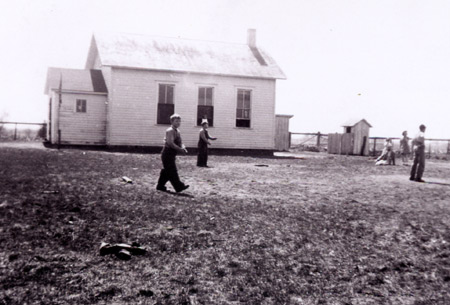
One-room schoolhouse, Johnson County, Iowa, date unknown (source)

A couple of years ago, people in our school district were intensely engaged in debating possible boundary changes between attendance areas. Now, we seem to have moved on (after making only very minimal boundary changes) to the topic of improving facilities and possibly building new schools. Having been unable to prioritize its building needs without angering large groups of people, the school board will apparently propose a bond issue that purports to fund everyone’s desires at once.

I didn’t write much here about the issue of boundary changes, and I expect I won’t write much about the facilities issue either. It’s not that I don’t think the issue is important; many of the arguments for facilities improvements are very persuasive. (I’m not sure whether to be happy or sad that our school’s roach infestation might get addressed in the district’s long-term plan.) But so much energy goes into discussing buildings and boundaries, and so little into discussing what goes on inside those buildings.

Will the conversation ever turn to whether we are offering a meaningful, humane education? To whether the district is too myopically focused on standardized testing, and whether it has taken a wrong turn with its increasingly authoritarian emphasis on behavior and discipline, and whether its curriculum is too lock-step and unengaging, and whether its demands on the kids are justified and developmentally appropriate? To the values that the district stands for, and its understanding of how people learn, and its conception of what it means to be well-educated?

Facilities aren’t entirely irrelevant to those questions. But given the choice between continuing our district’s current educational approach in shiny new high-tech buildings and pursuing a meaningful, humane educational experience in run-down World War II Quonset huts, I’d take the Quonset huts in a heartbeat.
.

Monday, October 8, 2012

What does this blog want?

Well, the blog is three years old today. A blog’s philosophy tends to come out in little pieces over time, so I thought I might use the occasion to try to put into words what this blog is ultimately about.

I’ve posted about a lot of topics here -- authoritarian education, behavioral rewards, standardized testing, school lunch periods, and many more -- but if you asked me to identify the central fact about K-12 education, I’d say this: Kids don’t get to vote. And when you don’t get to vote, you get screwed.

I’m not saying that six-year-olds should get to vote; kids are disenfranchised as much by their circumstances as by any law. But disenfranchised they are. And the history of enfranchised groups acting “in the best interests” of disenfranchised groups is a particularly sorry one. Think of the history of African-Americans, of women, of mental patients, or of prisoners. If there’s one thing we know, it’s that people cannot be trusted to act in the best interests of disenfranchised groups.

Our country’s treatment of children is a part of that history. I don’t mean that they are as bad off as slaves or prisoners, but they are similar in that they are seen as less than fully human, as more different from “us” than they actually are. At its worst, this means they get used for other people’s ends. I’m always struck by how openly politicians now express an instrumental view of children. They don’t even bother talking about what’s good for kids as individuals; the entire debate is about how we can best use kids as soldiers in the battle for global economic supremacy. (Granted, they may not see this as instrumental: What’s good for business is necessarily good for kids, right?)

Kids are at the mercy not only of those who would exploit them, but of those with the best of intentions. There has never been any shortage of clipboard-carrying “experts” eager to improve other people by coercing them into doing things they wouldn’t otherwise choose to do. The main protection adults have from being treated that way – from being seen that way – is their political enfranchisement. Kids don’t have that protection.

If someone were to give me a token prize in a transparent attempt to manipulate my behavior, I would feel patronized and used. If I were ordered by the government to use my free time to take classes that didn’t interest me, I would experience that as an unjust intrusion on my liberty. If I were made to sit silently in an uncomfortable chair at someone else’s whim, required to ask permission even to use the bathroom, given only ten or fifteen minutes to eat my lunch, and made to feel shameful or defective if I couldn’t comply with these “expectations” – all while being given no say over my treatment – I would quickly either become a revolutionary or settle into a clinical depression.

Yet we not only do those things to children, we think nothing of doing them. The idea that their freedom from coercion and manipulation might have value, like ours does – the idea that it should have any weight at all in our policy decisions – seldom even occurs to people. It’s as if children existed precisely for us to manipulate them. The guiding spirit of our treatment of children seems to be: “Look, there’s a child! Let’s do something to it! For its own good!

So what does this blog want? I want people to be more conscious of the moral hazard posed by their power over this disenfranchised group. I want them to be less quick to find reasons to treat kids differently than they want to be treated themselves. I want them to be more aware of the possibility that we might be acting out our fears and neuroses on our kids. I want people to take kids’ freedom, autonomy, and dignity as seriously as they take their own. I want people to recognize that the central ideals of our society – democracy, civil liberties, constraints on authority, the importance of the individual – do not suddenly become irrelevant and frivolous at the schoolhouse door.

One reason I want to see more humane, less authoritarian schools is because I want to see a more humane, less authoritarian world. I worry that our schools are reflecting and modeling some of the worst impulses of our society, which seems increasingly ready to curtail individual liberties in the name of “security,” increasingly prone to using human beings as a means to an end, as in our brutal foreign wars, and increasingly draconian in its approach to crime and punishment, as it imprisons a huge chunk of its own population. I worry that our schools are teaching our kids to accept and conform to that world. This blog wants to ask whether that has to be so.
.

Wednesday, June 6, 2012

What “supportive” could mean

A reader sends this link about a school that tried approaching discipline more in terms of helping students with problems than manipulating behavior through rewards and punishments.
A student blows up at a teacher, drops the F-bomb. The usual approach at Lincoln – and, safe to say, at most high schools in this country – is automatic suspension. Instead, [principal Jim] Sporleder sits the kid down and says quietly:

“Wow. Are you OK? This doesn’t sound like you. What’s going on?”

. . .

“We began focusing our concern on what we know that’s going on that might be causing behavior in a kid,” versus what type of punishment to mete out.

When a kid erupts in class, teachers intervene quickly. “A kid that I have a really great relationship with might blow up,” says [teacher Erik] Gordon. “So, I step out of the classroom with that kid and ask: ‘What’s going on? Because that was really intense.’ I know that something is bumming this kid out, because normally, we really enjoy each other.”

. . .

Instead of talking [in staff meetings] about disciplining problem kids, they focus on why that teen’s having problems, develop a plan to help the teen, and make sure to follow up.

In the last two years, the Lincoln High staff has noticed that the kids’ ability to regulate their own emotions has dramatically improved. “There’s not near the number of huge emotional explosions that there used to be,” says Gordon. “Even the way the kids interact with each other is more subdued.”

They way the kids see it is that the teachers have chilled out.
Some aspects of the article put me off a bit – some of it tends toward the propagandistic (does in-school suspension really take place in a “quiet, comforting room” where you can “talk about anything with the attending teacher”?), and I’m not sure we need concepts like “toxic stress syndrome” and the “trauma-sensitive classroom movement” to discuss basic ways of treating other people with dignity. But the system it describes seems to get a lot of things right. Its focus on engaging the kids as thinking, feeling human beings who might have articulatable reasons for acting the way they do is a vast improvement over an approach that sees kids as nothing more than collections of behaviors that can be modified through the right combination of rewards and punishments. (Notice, for what it’s worth, that Lincoln High says that its approach cut the number of disciplinary measures significantly, as opposed to, say, increasing them thirteen-fold.)

I do think even relatively humane approaches to discipline like this one (Collaborative Problem Solving is another) would benefit from more explicitly acknowledging an elephant in the room: kids are made to attend school, whether they want to or not, and are given no say in the rules that govern them there. Few us of would not chafe under those conditions. Some degree of resistance might even be a sign of intelligence.

In approaching discipline, I wish schools would try to follow at least these five principles:

1. Treat people the way that you would like to be treated in their place.

2. Do not treat children differently from adults unless you have sufficient justification, and do not be too quick to assume that you have sufficient justification.

3. Be conscious of the fact that kids in school (and out, for that matter) have been deprived of much of the freedom that adults take for granted, and that that might affect how they feel and act.

4. Be conscious of what your actions model about the relationship between authorities and the people they govern.

5. If a child is not meeting your expectations, do not assume that the problem is with the child, rather than with the expectations.
.

Saturday, June 2, 2012

Mind the gap

Yesterday’s post reminded me of a saying I once heard: “Expectations are resentments under construction.” As I understand it, the saying does not mean that people chafe and grow resentful when much is expected of them. Instead, it means that people who expect too much from others, or from life, are likely to end up disappointed and resentful. Applied to life, the saying is a little too dark for me. Applied to compulsory education, though, I think it has a lot of truth to it.

Teachers are only human. When you’re under pressure to get a class to master certain material on a certain schedule, or to live up to certain behavioral rules, it is only natural to feel frustrated and upset when the kids fail to meet the goals. If the kids still fail to meet them despite the teacher’s best efforts, I think most teachers would, at some point, reconsider whether the goals are realistic. But if those goals are imposed from above, and the teacher is stuck with them, it’s unsurprising if the school atmosphere becomes more adversarial.

Compulsory education, by definition, involves some degree of coercion, but some approaches are more coercive than others. There are strong arguments (for example, here) that the best way to promote learning is to accommodate kids’ interests and inclinations as much as possible, and to give them a relatively large degree of autonomy, rather than simply dictate what they must know, when they must know it, and how they must behave. But there’s another argument in favor of the more accommodating approach, separate and apart from its effect on learning outcomes: it is more conducive to a kind and humane school environment.

Our school officials seem to think that we need more emphasis on behavior and discipline because something in the nature of children has changed. I think their focus on behavior is more likely driven by a change in the nature of schooling: that we are increasing the gap between what we want to make kids do and what they are interested in doing. Increasing that gap is naturally going to lead to a more coercive, adversarial dynamic, in which schools are more likely to employ authoritarian practices and model authoritarian values, and in which school staff are more likely to feel frustrated and angry with the children and to treat them accordingly. Not all school staff will fall prey to that dynamic, but the greater the gap, the greater the odds.

Promoting a humane school environment has value in and of itself, separate and apart from its effect on learning, though you would never know it from today’s educational debates.
.

Sunday, May 13, 2012

There is no good indoctrination

Well, I didn’t have much luck getting the panelists on bullying to respond to my concerns about the potential for anti-bullying interventions to be counterproductive and to model some of the same traits they are trying to discourage. The goal of reducing bullying is a good one, but it doesn’t necessarily follow that every proposal to address it is a good one. Discussions about bullying are always well-meaning, but they often seem to proceed from an unexamined and very questionable premise: that we can mold kids’ values to order simply by telling them, in a sufficiently elaborate and pervasive way, what to think.

At some level, I think everyone perceives the word “indoctrination” to have a negative connotation – that it’s something a free society shouldn’t do, and that it’s the opposite of real education. But many people seem to make an exception when the message that is being indoctrinated is a commendable one (for example, that bullying is bad). That exception, of course, would entirely swallow the rule: people never think the message they are pushing on others is a bad one. The idea is similar to the idea that freedom of speech is great as long the speech isn’t really offensive.

There are good reasons to think that indoctrinatory approaches to behavior and bullying are likely to backfire. First, people naturally resist being told what to think. Second, indoctrination models a dehumanizing way of interacting with people. Our school’s approach to behavior, for example, treats kids as if they are incapable of reaching their own moral conclusions – as if they’re not fully people. I’d be worried about using an approach like that to discourage bullying, which is also a form of dehumanizing people.

I don’t think I’m saying anything very radical. A school can have rules about conduct, and can enforce them. Its administrators and teachers can explain to the students why they have those rules, and they can explain what the school’s values are and why. They can insist that the children follow the rules, but they should stop short of insisting that the children agree with the school on what are, ultimately, value questions. That’s where they cross the line from enforcing rules to indoctrinating minds. And any system of behavioral rules should be accompanied by an effort to get the kids thinking for themselves about right and wrong, without the school dictating right answers, so that the kids aren’t simply learning mindless obedience. (For a thumbnail sketch of what such an approach might look like, see this post.)

If school officials think they can just tell kids what to think about right and wrong, they don’t understand what a conscience is. Unless people are given the freedom to reach their own conclusions about what’s right and wrong, they can’t possibly develop real consciences, since a conscience sometimes requires you to do what’s right even when no one else thinks it’s right. That’s why herding kids into agreeing with the school’s rules and values by subjecting them to pep-rally-like behavior assemblies or having them chant memorized slogans couldn’t be more misguided. If you want people to develop their own moral compasses and to resist peer pressure, you don’t achieve that by appealing to their desire to please authority figures and conform to the crowd.

Bullying is real and has many causes, but many behavior crusaders seem eager to look for sources of bullying everywhere but in their own techniques for addressing it.
.

Wednesday, May 9, 2012

Indoctrination is a counterproductive way to address bullying

The Iowa City Patch has invited its readers to discuss the issue of bullying with a group of panelists. I’ve been chiming in with comments that will sound familiar to readers of this blog – for example:
In addressing the bullying issue, people should be mindful of the difference between persuasion and indoctrination. Trying to use reason to persuade people to a set of values is a respectful way of engaging with people. Indoctrination – telling people what to think – is not. Indoctrination is a form of dehumanization, just like bullying, and is part of the problem, not the solution.

Right now, the approach of the Iowa City schools is indoctrination. The behavioral rewards program used in all the schools (“PBIS”) is entirely about telling the students how to act, and then using material rewards to get them to comply. It has no component designed to get the kids thinking for themselves about right and wrong and how to treat other people. In the end, all it teaches is obedience to authority.

I’m not saying the schools shouldn’t have rules. But simply dictating rules does nothing to help kids develop their own moral and ethical reasoning about how to treat other people. Without more, it just models treating people like objects to be bossed around and manipulated.

If we want kids to treat each other with dignity, we need to treat them with dignity, and engage them in reasoning about what’s right and wrong – not just tell them what to think.
So far, the panelists have had little to say in response to my comments, but the thread is still developing . . .

Update here.
.

Wednesday, February 22, 2012

Are liberal homeschoolers hypocrites?

I recently went to an interesting talk by Heather Gerken on the various ways that political minorities can influence policy within a federal system like ours. I won’t go into her specific thesis here, but she built on the work of earlier scholars such as Albert O. Hirschman, who recognized that people can influence institutions through both “voice” and “exit.” In other words, you can try to change the system from within by speaking up – though, if you’re in a political minority, you might find yourself outvoted. Or you can influence the system by voting with your feet; if enough people “exit,” the institution might eventually have to change.

I thought about those ideas when I read Dana Goldstein’s article titled “Liberals, Don’t Homeschool Your Kids.” Goldstein argues that liberals are violating their own ideals by withdrawing from the public schools. If they really cared about “society as a whole” and not just themselves, she says, liberals would “flood” the public schools with their kids, “and then debate vociferously what they ought to be doing.”

I suppose I’m someone who has taken the “stay and fight” approach, though more because of circumstance than principle. But I think Goldstein’s argument is myopic. She ignores the potential of “exit” to bring about positive change, and overestimates the potential of “voice.” Unlike Goldstein, I fully expect that for all my attempts at vociferousness, my kids – like those of countless people who have “stayed and fought” – will graduate thirteen years later from an utterly unchanged institution, if not one that has changed for the worse. If you were trying to design an educational system that would minimize parents’ “voice,” it would look a lot like this one.

Goldstein argues that if people who can afford to homeschool sent their kids to public school instead, less advantaged kids would benefit from their presence. I think that’s probably true, at least to some extent. But she doesn’t acknowledge that there are costs to that choice as well – not just to the kids who would have been homeschooled, but to society as a whole. Goldstein seems to think that liberals should send their kids to public schools no matter how illiberal those institutions are, and no matter how successfully they are instilling illiberal values in the kids who attend them. I think today’s schools are profoundly undermining liberal, humane, and democratic values. Why should that ever change if liberal parents continue to patronize them regardless of what they dish out?

Again, I’m not a homeschooler, and I don’t particularly care whether anyone thinks I’m sufficiently liberal. But I certainly don’t judge anyone who chooses to take their kids out of these schools. There’s no one right answer to how to make this world a more humane place, and the homeschoolers’ answer seems at least as wise as Goldstein’s. If anything, I instinctively distrust the idea that we can create a more liberal and humane society by putting our kids into less liberal and humane environments. By treating kids as instruments for social improvement, that argument mirrors the very same instrumental treatment of children that I object to when it’s practiced by “reformers” who treat kids as soldiers in the battle for global competitiveness. The homeschoolers think that you build a more humane society not by using kids to achieve this or that social end, but by treating kids humanely, one at a time. Can Goldstein be so sure that they are wrong?

More on liberal homeschoolers here. Related post here.
.

Thursday, February 16, 2012

Too sane for us?

Busy week, not much time for blogging. In the meantime, check out Diane Ravitch on Finland’s sane, humane educational system, and on the determination of American “reformers” (including both major parties) to learn exactly nothing from it.
.

Monday, December 12, 2011

Some thoughts on “bullying”

Glenn Greenwald has a post up about the use of the word “terrorism.” An excerpt:
This topic is so vital because this meaningless, definition-free word — Terrorism — drives so many of our political debates and policies. Virtually every debate in which I ever participate quickly and prominently includes defenders of government policy invoking the word as some sort of debate-ending, magical elixir: of course President Obama has to assassinate U.S. citizens without due process: they’re Terrorists; of course we have to stay in Afghanistan: we have to stop The Terrorists; President Obama is not only right to kill people (including civilians) using drones, but is justified in boasting and even joking about it, because they’re Terrorists; of course some people should be held in prison without charges: they’re Terrorists, etc. etc. It’s a word that simultaneously means nothing and justifies everything.
I wonder if a similar phenomenon is starting to occur with the word “bullying.” Of course, no one likes a bully, and we’d all like to see less bullying in schools. But when I hear people talk about a “War on Bullying,” and about “crackdowns” and “zero tolerance,” and when I hear the word applied to an increasing range of conduct (see Iowa City’s definition here), I get an uncomfortable sense of deja vu. I can’t help wondering whether the word “bullying” is being used as a rhetorical tool to generate support for – or quell opposition to – the schools’ use of increasingly authoritarian practices to “manage behavior.” Is policing more conduct and punishing more kids the best way to teach kids to treat each other well?

I don’t think we should take the War on Drugs, for example, as our model for how to address a social problem. Bullying, like drug abuse, is a real problem, but it doesn’t automatically follow that a heavy-handed law enforcement approach is the solution.

This is particularly true in the context of bullying, because the more schools use coercion to address bullying, the more they are modeling coercive behavior. The school, after all, is telling the kids how to act, giving them no say in what it demands of them, then policing their behavior and punishing them if they don’t comply – sometimes even casting them out of the community (via suspension or expulsion). Schools can’t avoid doing some of that. But consider how often “bullying” resembles those same actions. Is it possible that some of the bullies are acting out what they see around them? How confident can we be that, if the school intensifies its focus on punitive enforcement, the kids will start to treat each other better instead of worse? And shouldn’t we be concerned about the other values that end up getting taught – even to the “well-behaved” kids – the more the school starts resembling a police state?

Greenwald and others have also written about the double standard that often applies when the words “terrorism” and “torture” are used to refer only to what other people do, and not to what we do. Similarly, it’s hard to come up with a fair definition of “bullying” that wouldn’t apply to some of what schools do to kids in the name of compulsory learning. When one kid coerces and intimidates another, it’s “bullying.” When the school coerces and intimidates the kids, it’s apparently something else – maybe “enhanced education techniques”?

The first step to addressing bullying should be to model humane treatment of other people. Schools, given the power they have over the children who attend them, are in a particularly good position to model humane treatment of those who are weaker and more vulnerable. Wouldn’t that necessarily involve giving them some say over their own treatment? Wouldn’t it involve treating them more gently, and with more understanding, dignity, and compassion, than one could get away with? What else is bullying but a disregard, through superior force, of those principles?
.

Thursday, October 27, 2011

Occupy Iowa City on education

Occupy Iowa City encampment, College Green Park

A reader points out that Occupy Iowa City, our local offshoot of the Occupy Wall Street movement, has posted a statement of principles that includes these paragraphs:
We witness the degradation of public schools which do not provide the skills needed for creative and free thought, or for full participation in economic or political systems.

. . .

We affirm the necessity of affordable public education for all people, so that they may be fully informed, creative and curious participants in a just society.
I’m very sympathetic to a lot of the concerns that the Occupiers have raised, if not to all of them in every particular. Those statements about education are, of course, unspecific and designed to appeal to a broad range of people. But I don’t think I’m projecting -- especially given their other principles -- when I conclude that the protesters would probably share my concern about public schools that seem designed to produce compliant subjects of a totalitarian state rather than skeptical, questioning citizens capable of participating in a democracy.

I’m also glad to see any acknowledgment that the disturbing economic and political trends in our country -- the increasingly authoritarian view of government, the decline in civil liberties, the two-tiered system of justice, the disproportionate influence of the wealthy, the militarism, the pitting of people against one another to fight over a smaller pie -- might be related to how schools are treating our kids.

I don’t know where this movement will go, but right now, these people are saying some things that need saying.

Related post here.
.

Saturday, October 8, 2011

Does the Governor love my child?

“I love my child,” a homeschooling mom once said to me. “Does the teacher love my child?” That’s as good an explanation as I have ever heard for homeschooling. It’s also, I think, a good argument for local control over educational policy. The teachers, in my experience, do at least have relationships with the kids and care about them as individuals. Do the school administrators? The superintendent? The Secretary of Education? The Congressperson?

The best way to put power in the hands of the people most likely to treat kids humanely -- that is, parents and teachers -- is to give local communities real control over their schools.

(I didn’t want to let the blog’s second birthday go by without a post. Looks like I just made it under the wire.)
.

Wednesday, August 3, 2011

“Wishing doesn’t make it so”

Freddie deBoer has some good, if painful, advice for school “reform” enthusiasts:
Educational policy is the graveyard of superb ideas.

. . .

Every year, a new, supposedly revolutionary text emerges that challenges our core understandings of pedagogy, which asks us for an entire new educational philosophy, which is sure to spark massive change in our schools....

. . .

We have to consider the possibility that improving educational outcomes will always be expensive, frustrating, and slow, and the gains tenuous. We have to consider that this might be reality.

. . .

Among the most frustrating elements of debating education reformers is that many tend to speak as though they are the first to ever “put their foot down.” When you study the history of education reform, you will find that one thing that has never been lacking is earnest, well-meaning white people talking loudly about how something must be done. I assure you: if the presence of impassioned, minimally-involved liberal strivers in the education debate guaranteed progress, we’d have achieved far more than we have. I expect and welcome discussion of education reform from passionate popular/generalist sources. That’s democracy. But I do wish people would understand that it is no coincidence that teachers and administrators at public schools tend to have a much more limited and skeptical view of reform. They live where education happens.

. . .

Educating is hard. Doing responsible social science is hard. This debate is desperately in need of modesty. Adjusting your expectations downward is not nihilism, and it’s not despair. It is reacting to decade upon decade of discouraging data.
I like deBoer’s call for modesty. I admit, though, that I’d be less bothered by the grand schemes of education reformers if they involved treating kids with more respect and giving them more independence and autonomy, if they were less burdensome and coercive, and if they were less likely to model authoritarian values.

The unspoken premise of most educational debate is that the ends justify the means. If it will “improve outcomes” -- that is, raise test scores -- then we should do it, period. It’s an ethically questionable premise at any time -- God help us if research ever shows that corporal punishment raises test scores -- but it’s a particularly questionable one when we know so little about the real long-term effects of any educational proposal. Especially in that context, doesn’t it make sense to let our treatment of children be driven by our values, rather than by pie-in-the-sky hopes that treating kids harshly will “improve outcomes”?

Read deBoer’s whole post.
.

Monday, June 13, 2011

Parents vs. politicians

Helen Gym on how our schools increasingly bear no resemblance to the schools parents want for their kids:
-- While parents talk about programs rich in the arts, sciences and history, politicians talk about covering the basics through a one-size-fits-all curricula.

-- While we talk about building critical thinkers and creative problem-solvers for a complicated and dynamic world, they talk about hiring billion-dollar testing companies that infiltrate every aspect of teaching and learning, drilling the notion of knowledge down to a single test score.

-- While we talk about smaller class sizes to help students and teachers build nurturing relationships with one another, they talk about maximizing capacity and “creating efficiencies.”

. . .

And in this lies the critical difference between what many parents see as their hopes for a quality school system and the politicians and billionaire venture philanthropists dominating the education reform landscape. The latter have become so enamored with the structure and management of education that they’ve forgotten about the substance and practice of it.
Unfortunately, in the political system we’ve created for ourselves, it is not in the interests of politicians to take ordinary parents’ opinions into account. Ironically, I discovered this article through a tweet by our school superintendent.

Read the whole thing.
.

Monday, June 6, 2011

Great news! Boot camps for poor kids!

America’s education reformers are fawning over the “Knowledge is Power Program” for charter schools, the latest manifestation of our national love affair with authoritarian -- er, I mean, “tough love” approaches to education. KIPP schools believe in a long school day (some schools go from 7:30 am to 5 pm, with two hours or more of homework a night) and a long school year (with Saturday classes and three weeks of summer school) -- resulting in 67% more time in class than typical public school students. Discipline is emphasized. Students are taught to “sit up straight,” “nod,” and “track the speaker with your eyes.” Teachers use chanting, repetition, and clapping and posture rituals. (See FedUpMom’s posts on the topic here.) KIPP’s promoters claim that it boosts achievement as measured by test scores and college acceptance rates, though these claims are, of course, disputed.

Many people love the idea of making the KIPP option available to the urban poor. But Dana Goldstein reports that there are “troubling questions” about whether middle-class and affluent parents are willing to send their own kids to KIPP schools, which present “particular challenges to parents who are accustomed to the schedules and social routines of high-quality neighborhood public schools.” She describes one suburban mom’s experience of enrolling her child in a regionally-based KIPP kindergarten:
Kerryn Azavedo, a graphic designer in Lincoln, Rhode Island, pulled her son out of Blackstone Valley after his kindergarten year, dismayed by what she calls the school’s overly strict discipline policies and lack of after-school activities. She complained that Blackstone Valley’s extended school day, from 7:45 a.m. to 4 p.m., left her son exhausted and with little opportunity to participate in organized extracurriculars. (Extended learning days were originally intended to provide enrichment for poor children whose parents are unable to provide after-school supervision or activities.)

When Azavedo brought her concerns to the Blackstone Valley administration, “I never felt welcome,” she said in a phone interview. “They say, ‘This may not really be for you, somebody else might really need your spot, you’d be okay wherever you went.’” Azavedo didn’t like the fact that the school lacks an independent parent-teacher organization; instead, administrators organize parental involvement. And she was surprised to learn her son had sat for standardized tests five times during the school year, and unhappy that the school did not notify parents of each individual testing date.

Though initially attracted to the idea of an integrated charter school, Azavedo is now actively organizing against the opening of new Rhode Island Mayoral Academies throughout the state. “If it’s not good enough for mine, dammit, it’s not good enough for yours,” she said. “I can do something about it because I’m an in-tune parent. I bought it for a year, but I caught on.”
I can see why parents who are poor and stuck in a really bad school district might enlist their kids in a KIPP school. They’re trying to beat some tough odds and could reasonably decide that KIPP is their least bad option.

But is it surprising that the KIPP model might be unappealing to middle- and upper-income parents? Maybe they’re happy to leave KIPP schools to the urban poor for the same reason they’re happy, on the whole, to let poor people staff the prostitution industry: Because they’re not that desperate yet. Maybe they can see how oppressive and dehumanizing the KIPP model is, and are fortunate enough that they don’t need to do that to their kids.

Does that necessarily mean we should take the KIPP option away from the urban poor? No. But it’s hardly cause for celebration that urban poor families are so bad off that they’re grateful for options that more fortunate people won’t even consider. If we support prison-like schools for the urban poor while declining to impose those schools on our own kids, we have good reason to feel queasy -- especially at a time when the government seems uninterested in addressing urban poverty in any systematic way.

Goldstein, by the way, notes “that although other charter school models are less trendy, they do exist.” She mentions Community Roots, “a diverse Brooklyn charter based on more traditional philosophies of educational progressivism and activity-based learning. The school is overwhelmingly popular with both middle-class and poor families in its neighborhood.” How much money is being poured into studies designed to show that those schools “work”? How much attention is being lavished on them by educational pundits and “reformers”?

I’ve been mixing it up with people on this issue in the comments over at E.D. Kain’s blog. For someone who claims a big libertarian streak, Kain is surprisingly unbothered by what goes on in KIPP schools -- disappointing.
.

Monday, May 16, 2011

The latest links

A few interesting links (with tantalizing excerpts!):

E.D. Kain reviews “The Finland Phenomenon,” a new film on Finland’s sane and successful approach to education:
To be honest, I finished the film feeling a bit angry – angry that for all the talk of school-choice in our current education debate, the choices available to me and to my children (not to mention the countless people far less fortunate than myself) are really false choices. No matter whether you attend a public school or a charter, you are really bound to the modern testing regime.
Emily Yoffe’s review of Race to Nowhere in Slate:
At a screening I went to, at a school in Montgomery County, Md.—which has one of the highest ranked school systems in the country—the parents who took to the microphone afterward could barely contain their outrage.
Alfie Kohn on “Ten Obvious Truths We Shouldn’t Be Ignoring”:
If we all agree that a given principle is true, then why in the world do our schools still function as if it weren’t?
How to sell recess and gym to school administrators:
Physical education classes may be scarce in some schools, but an activity program combined with school lessons could boost academic performance, a study finds.
.